
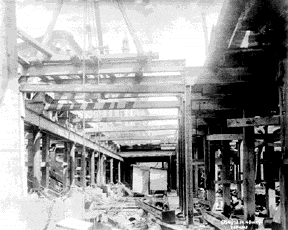
THE EXPRESS STATION at 72 Street was like Grand Central Station, because it only had island platforms, and no side local platforms. The walls at this station display a distinctive "vertical rug" pattern, which also once graced the walls at Bowling Green station, before a 1970's renovation covered the walls in red brick. There are no name panels that say "72 ST." on the walls at this station. Also as at Bowling Green, one enters the station at street level in an entrance house, and then proceeds down to track level. Unique to express stations, there is no uptown/downtown transfer available here because of this arrangement. An entrance house that no longer stands also existed at the 116 Street station. This station is often notoriously crowded because of its narrow platforms and staircases. THE PHOTOGRAPH well illustrates the prevalent construction technique for the original IRT, cut and cover. The street would be torn open, and construction of the subway would go on with a temporary covering on the street. Then the street would be repaved and permanently covered over again. So in one sense, much of New York's first subway line was not true tunnel. Some segments, however, were true tunnel that was bored; the Murray Hill tunnel near 33rd Street is a good example. |
 |
66 Street | 79 Street |
 |
[City Hall] [Brooklyn Bridge] [Worth St.] [Canal St.] [Spring St.]
[Bleecker St.] [Astor Place] [14 St.] [18 St.] [23 St.] [28 St.] [33 St.]
[Grand Central] [Times Square]
[50 St.] [59 St.] [66 St.] [72 St.] [79 St.] [86 St.] [91 St.] [96 St.]
[103 St.] [110 St.] [116 St.] [125 St.] [137 St.] [145 St.]