
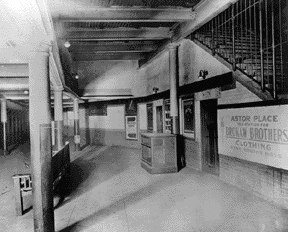
THE UPTOWN PLATFORM of Astor Place station is shown in this photograph. There is now a newstand where the women's restroom was once located, although the doorway and the sign above it remain. The beaver at Astor Place station, visible near the center of the photograph, is a symbol of John Jacob Astor's fur trade, and is probably the best known of the subway's decorative ceramic and mosaic work. The vault lighting has been replaced by a lower hung ceiling. The metal railing shown next to the staircase survives, as it does in many stations. Original IRT railing can be identified by the presence of a small circular "knobs" near the top. The downtown platform features several brick rectangular pillars, which once supported the Wannamaker Department Store, whose show windows in the station are now used by Kmart, which currently occupies the site above. A late 1980's renovation at this station replaced the walls of the platform extensions with a treatment that harmonized more with the original station, and also brought back a kiosk to the uptown platform entrance. The 1904 IRT book notes that "the entrances to the underground stations are enclosed by kiosks of cast iron and wire glass;" most of these were removed by the 1950's, and replaced with the simple entrance found everywhere today. The Astor Place kiosk is a replica of an original one, made at the same factory as the originals. The design of Astor Place station is very similar to that of the 50 Street and 66 Street stations. |
 |
Bleecker Street | 14 Street |
 |
[City Hall] [Brooklyn Bridge] [Worth St.] [Canal St.] [Spring St.]
[Bleecker St.] [Astor Place] [14 St.] [18 St.] [23 St.] [28 St.] [33 St.]
[Grand Central] [Times Square]
[50 St.] [59 St.] [66 St.] [72 St.] [79 St.] [86 St.] [91 St.] [96 St.]
[103 St.] [110 St.] [116 St.] [125 St.] [137 St.] [145 St.]