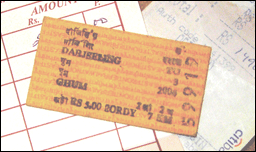
Exchange rates used:
$1 =
Departure for Chennai
Dave and I were seated together for the uneventful and short-seeming flight. I watched the movie "Wall Street" for the first time. It was a pretty landing, with the suburbs of London looking deceptively neat and tidy in the clear dawn light. Dave and Don were both amazed that our flight was able to land at Heathrow without any circling.
Arrival in Chennai It was broad daylight by the time our flight was underway, and from my window I could just see the winding River Thames and City of London, followed by the Channel, what I suppose was the countryside of Belgium, and then clouds for the remainder of the day. We hit minor turbulence over Turkey. We spent hours over Asia Minor and Iran, then Pakistan as it turned to night. I thought I could see the Indus River out the window in the moonlight, desert sands making a contrast with dark rock mountains and perhaps forested or agricultural riverbeds. We arrived in the early morning hours at Chennai International (MAA), with its oldish airport terminal building where several international marks of 747s were waiting on the tarmac. Dave and I had a trying time waiting in line at Immigration. Several people cut blatantly in front of us, then our line was blocked by someone taking a long time to be processed. I was the last person through the Immigration line. Dr. Naman and Mr. Radhakrishnan - both grinning and clearly enthusiastic - met us in the throng waiting outside the Customs Hall, and we had a good conversation with them because Anand had a long wait for his baggage (perhaps redress for beating us through Immigration). Dr. Naman and Mr. Radhakrishnan discussed practicalities with us as we found our hotel's driver and made our way to the hotel through the fairly crowded streets at around 2:30 in the morning. On the streets I watched the motorcycles, Ambassador cabs and battered old autorickshaws, and the laying of a water or sewer pipe being done by hand by a mass of men, women, and children laborers digging in the dirt by hand in the middle of the night. The hotel featured a sumptuous marble-veneered atrium, glass doors handled by numerous doormen, one of whom wore a black stovepipe hat. Dave and I had trouble checking in, since the men at the desk didn't understand our request for a room with two separate beds. Per and Don joined us in our room for a few shots of warm gin, and we turned in at around 4 am, exhausted and giddy.
A Guided Tour from Mr. R. Mr. Radhakrishnan met us around 10 with his hired driver. We whizzed through the crowded streets in our hired Qualis and made our way to a clothing store. We met Priya and Mrs. Radhakrishnan and helped Anand pick out his kurta or sharwani - I'm unsure of the terminology here. After some trying on and persuasion, Don, Dave, Per and I purchased our very own kurtas. Mr. Radhakrishnan gave us our first experience with Indian price negotiation, insisting tax be waved and that we get a group discount, which he bargained down to 7.5% (the last .5% was "on principle," Mr. Radhakrishnan said). For lunch we went to a restaurant with combination buffet and fixed menu Lebanese lunch that included waffles, Lebanese dishes, and dessert that many of us hadn't saved room to eat. Then some sightseeing: after some consultation with the map and after Anand told Mr. Radhakrishnan of my desire to see some train stations, we dropped by Madras Central Station as well as Egmore Station. Both were rundown Victorian red-brick affairs with what were once graceful turrets or cupolas, picturesquely boarded up or hung with laundry. Central Station's otherwise faded interior included some brand-new flat panel TV displays. From there we went to Marine Drive, passing by old Ft. George with its ship's mast, then driving out onto the beachfront road where we saw the markets and cricket games being played on dirt pitching mounds set up right on the road's asphalt. (Several games were interrupted by our driving past.) We got out of the vehicle to look at the monuments to various state leaders, some of them treated as shrines by the local population, and to look at the concrete berms that had been knocked down and pushed inland by the tsunami. Next we drove to St. Thomas church, a simple Western structure with a shrine to St. Thomas in its basement where Indian devotees were prostrating themselves in a fervent manner unseen nowadays in most Christian areas of the world. Mr. Radhakrishnan and Mala both amused the driver by wondering aloud why we weren't walking around the church clockwise, as is done at Hindu temples. "These Christians don't care, they walk around it any way they please!" the driver said in Tamil, according to Mala. Our next stop was Mylapore temple, Chennai's premier temple in the south of town. We arrived around sundown. The change in atmosphere was incredible. Beggars approached us as we got out of the Qualis and we had to take off our shoes to walk over the temple's threshold. There we saw our first glimpses of what, to the Westerners, was a truly foreign experience: the recorded mantras glorifying Shiva; the fancy, baroque temple gopurams with intricately-constructed scenes from the Hindu epics carved and painted on their flanks; the portion of the temple dedicated to the planets being circled by devotees; and in the dusk sky a waxing gibbous moon hanging over it all. As we left the temple Anand ruined the mood by taking a cell phone call.
Photo: Chennai station
Madurai A driver met us and took us to a hotel where we were scheduled to shower and freshen up. Don joked with Dave about the travel vouchers, which was one of Dave's worries. We showered and had breakfast, then met Meenakshi (she of crooked teeth and broken English) for our tour of Madurai. Meenakshi said tourists were staying away due to the tsunami. Our first stop was the tank with its temple island. At a January festival Shiva and Parvati are brought there to encourage the river to flow with the spring runoff. We saw weavers there washing and wrapping silk threads, schoolkids of many-colored uniforms eyeing us. Inside the temple was crowded with hawkers; we saw sculptures of Shiva nataraj and Shiva in a one-breasted man-woman incarnation, dancing Ganeshas, and a column used for drumming. We saw some Western tourists walking the wrong way around the temple. Don joked with Meenakshi about how many columns there were in the 1,000 column hall. Next our guide took us to a scenic overlook at the temple's south entrance that turned out to be part of a rug store. We sat down for tea and heard the owner's sales pitch, which was exactly like the one I'd heard in Turkey one year earlier. Don kept egging on the salesman: "Isn't that exactly what you were looking for, Dave? That looks like it might be right in your price range, don't you think, Dave?" When Don went to the bathroom I told the salesman we wouldn't buy anything and wished to leave. We made a quick exit - and Dave was saved.
Photo: Temple and the gang As we got back in our Qualis we were suddenly mobbed by beggars. To pay our guide without their harassing us we had to get her into the van before handing her the money. From there our driver took us through the cattle-thronged streets and then out of town, heading to a hill resort near the Kerala border. We ate a buffet lunch in luxurious surroundings. The resort staff went so far as to garland us under the assumption we were guests, only to have the garlands left behind when we departed. We drove to Periyar Landing nearby, and experienced some confusion about travel vouchers for the boat ride on the wildlife refuge's lake. We waited in the visitor's center, a scenic spot above the lake where we could watch the activities of the other tourists snaking up and down the path to the boats tied up at a makeshift dock out on a sandbar stretching into the partly-dried-up lake. At last we boarded a boat after paying for binoculars and providing our voucher to the right people. On deck we sat on white plastic lawn chairs amidst a larger group of German tourists. Two or three other tour boats plied the waters - all the boats would cluster together whenever someone spotted an elephant, playing otters, Indian deer, or a fantastic blue bird. I made a $1 bet with Don that we would not see a tiger. (I gave 4:1 odds, and the old bastard never paid me back.) Dave and Per both dozed. The gentle mountain scenery and perfect climate was the highlight. Back on the road darkness fell as our driver took us over winding pockmarked roads. He got lost. We returned several times to the same forlorn crossroads in the forested mountain ridges as we boys sang popular songs. Per and Don worked on rap, and I interrupted with a verse from Gilligan's Isle, "a three hour tour... a three hour tour..." Finally we reached our resort at Thekkady. We had a quiet dinner buffet. Keralan food is slightly different from that in Tamil Nadu, and the chicken was bony. In our room we sipped some warm gin and chatted. "Life is hard," I joked to Don. In the evening we slept hard, and according to Dave I sleepwalked to the window and shouted, "Hail the ocean!" before Dave could persuade me to go back to bed.
Kerala backwaters In another hour we arrived at a dirt quay on a canal near town where we boarded a beautiful rattan houseboat or kettuvalam. Seshi was the director or maitre d' of our journey, heading a four-man staff. After a few minutes of preparation the motor fired up and we cast off and headed down (or up?) the canal. We five Westerners took in the scenery and views of the other houseboats with a relaxed and casual attitude that seemed perfectly natural and perfectly easy. We discussed what we knew of the houseboats: apparently they were developed by a British tourist who enjoyed the food he found on merchant boats on the backwater canals. We didn't know when this happened (nor could I learn later from the Internet). We wondered how many boats there might be: Seshi assured us there were hundreds, 300 in Aleppy alone. We guessed 1000-2000 total. After a moment pondering this thought we all dropped the practice of waving to fellow tourists sighted on the canals. And so we settled into the rhythm of the water. Now and then we'd spot a flagpole carrying the hammer and sickle of the Kerala Communist Party. Jon Landry clicked away with his camera.
Photo: Kerala houseboat
Photo: Kerala kids I slept on a mattress placed on the bow, under the stars. Back to Chennai for the Engagement Ceremony
Photo: Sunrise Our driver met us at the bank and quickly drove us through difficult traffic to the Kochi airport. The airport is inland from Kochi proper so we didn't see any of the old city, only the outskirts with some occasional modern, Miami-style apartment buildings. The airport was large and modern, but I was frustrated there because of my inability to use my gmail account. I bought a chocolate bar and waited for the airplane in the plush individual seats in the departures hall. The Jet Airways plane was the first I've flown on with wings placed above the fuselage; the prop-plane sort of made the airline's name seem paradoxical. The takeoff was easy; the views were of the Kerala hills and the plains of Tamil Nadu. There was a complementary newspaper and full meal despite the flight lasting only 90 minutes. We were met at the Chennai airport by Vincent of the Residency Hotel staff, but there was confusion owing to the lack of sufficient vehicle space. We were anxious about getting to the wedding hall on time for the engagement ceremony. Back at the hotel I knocked on Elaine Wong's door and retrieved my wedding clothes, emailed mom and dad from her laptop, and donned my kurta-pajama since I lacked Western-style clothing. We were driven to the wedding hall, and then immediately shunted downstairs to the dining hall for our first meal on banana leaves. 15 to 20 servants were standing in a row, each waiting to dollop chutney or hand us poori breads the moment we finished eating any given item. However, Anand was eagerly awaiting our arrival so we could witness the ceremony, and ultimately stopped the ceremony to send his sister Mala down to retrieve us.
Photo: Wedding musicians Back at the hotel Don, Per, Carl, Elaine and I met for drinks at the New York-themed bar. Don and Elaine paired off, as did Carl and Per, leaving me out of the conversation. I left after 10 minutes. The Wedding Following the ceremony we returned to the hotel. Anand decided to cancel an afternoon ceremony because of general exhaustion. Instead, the wedding party went on to Fisherman's Cove, a resort south of town. We soon learned that Anand, Mrs. Radhakrishnan, Ananth, Mala, and several others had fallen ill. At dinner I cracked jokes about our Kerala voyage (which had been splendid). Anand arrived at the patio restaurant looking wan. Moments later I saw him vomit in the shrubs off to the side. Later that evening I mistakenly deleted all of my pictures on my digital camera, almost ruining the rest of the evening.
On the Bay of Bengal
Photo: Sunrise
Photo: The village As we reached the gate to Mahabalipuram I told the group (as per the LP's suggestion) that we should avoid touts and self-described "guides." From the moment we stepped out of the Qualis we were hassled by people with postcards, baubles, and offers of guiding. Per ended up paying two men just to leave him alone. First we saw the cave carvings (and crouching monkey statues) and the lighthouse that overlooks the cave complex. We moved along to the set of shrines that includes temples to the trimurti and the well-known elephant whose rear faces the park entrance. Finally, we drove to the Shore Temple, paid the foreigner rate to enter, and walked around in the hot sun. We were hailed and waved down by a man who, inevitably, wanted to guide us and get money from us (and someone in our group did pay him). We learned there had been several pagoda-sized temples in a row, but the sea had overrun them in the centuries since the Pallava Dynasty. There was some minor tsunami damage to a rock retaining wall in the rear of the temple complex.
Photo: Mahabilipuram
Indian Scenes On the advice of Mr. Radhakrishnan our driver initially took us to Chidamburam via Pondicherry. In Pondicherry we got out of the car to look at bookstores by the main square (I bought two Hindu-epic-themed cartoon books for Dhaya) and we got some tea at a hotel. We noticed mostly the poverty, the dirt, and the homeless people sleeping in broad daylight in the park. We did feel the streets were more walkable than in Chennai, with a handful of cafes and hotels welcoming visitors here and there. Only on the drive out did we notice a kepi-hatted man. I really wasn't surprised that in our brief stay we didn't notice anything French other than a couple of signs. In Chidamburam we learned that the Shiva temple Mr. Radhakrishnan had told us so much about, the one where he had his fortune told from palm-leaved Sanskrit scriptures on a visit from the U.S. just after his marriage, was closed from 12 to 4. The main gopuram appeared to be thatched or perhaps swathed in scaffolding, and we didn't see any dramatically-colored sculptures on its exterior. Instead of seeing the temple we got thalis at a dingy and dark restaurant (they didn't initially give us the vegetarian menus). Outside I used a squat toilet for the first time, surprised at my own dexterity, endurance, and stomach. Afterwards we directed the driver to a hotel with what proved to be a pathetically-slow Internet connection, and I sent my mom and dad an email using Dave's account.
Our conversation with the driver amounted to snatches such as the following:
Photo: Our driver In the evening we walked around a few blocks of the neighborhood surrounding the hotel at dusk. We saw the open sewers, the wood-burning street-stalls making chapatis, the people lining up to perform puja at a tiny street temple, and the mixed animal- and motor-powered traffic above all. Tanjore to Trichy We dropped our shoes in the chalk squares marked in the ground outside and entered the several gates of the temple/fortress complex. There was an elephant at the gate, beggars, fruit-sellers. The unpainted gopurams were brilliantly lit in the morning sunlight. Ganesha and Shiva figures looked down on us all around. The walls were topped by carved sitting bulls, hundreds of them ringing the complex. I took a picture of a child, Chindum, and spoke with him and his brother Adesh briefly, letting them know we'd be in their home town of Mysore in about a week. We also paid the temple brahmins a few rupees to light tealight candles at the Shiva shrine and have shaivite marks smeared on our own temples.
Photo: Tanjore temples After the tour we took our second autorickshaw ride to the hotel at around 11 am for lunch and then had a look at the train station nearby. The first train was at around 4 pm, so we returned to the hotel to read our books for a while. A train ticket for Trichy cost only Rs 24 for two, less than $0.60. At 3 pm we checked out and walked through the sewage-smelling streets, along the dirt sidewalks to the station, where we waited a bit before I started asking around as to where the train might be. It had been there all along on another nearby track. We selected two wooden bench seats across from a middle-aged man; soon there were four people crammed in each bench with others standing or squatting on the floor. As the train got underway the views were of concrete houses, thatched huts, people tending cattle, carrying hay, piling it by hand, naked kids, and sewage ponds.
Photo: Indian switcher First we had a brief stroll in the Trichy Cantonment neighborhood with its dirt sidewalks, open sewers occasionally paved over with cement stones, the crowded bus station near the hotel, the open-air vegetable stalls, and the army base. We returned shortly to grab drinks at the Wild West bar, a Royal Challenge scotch for me. We met a group of Americans: Philip, Jesusa, John, and Michelle. John, the ex-hippie with floppy gray mustache and ponytail who had been all over India by rail, knew immediately from our description of the wedding that Anand and Priya had been brahmins from Palaghat area by heritage. In the hotel restaurant we had a good South Indian dinner for a couple U.S. dollars, then turned in early. Temples and Touts in Trichy
Photo: Trichy gopurams One of the largest gopurams, at the entrance where we came in, dated to only 1987, and blue and white-painted signs on the corners advertised temple-construction services; these temples are very much works in progress. One gopuram seemed white, waiting for a coat of multi-colored paint. We walked back along the dirt shoulder of the street, agreeing on a new negotiating tactic of suggesting a price for the autorickshaw. At one corner we suggested Rs 40 to the fortress; the drivers glanced at one another and acted confused, finally responded with an offer of Rs 60, stating that this was a "flat rate" of some kind. We walked off and moments later one of the same drivers coasted up behind us to accept our Rs 40 suggestion. We arrived at a corner near the fort, a street lined with shops and some sophisticated-looking box-style Indian clothing stores. The fortress is more of a temple than a fort, so we again had to remove our shoes. We had to climb a few hundred steps to the top, first through darkened passages, then up the curving side of the original granite rock face of the outcrop, both paths filled with worshippers and elderly mendicants, their hands outstretched on the pavement. The sides of the steps were painted red and white vertical stripes in Shiva's honor. At the top there was a small temple, complete with temple-brahmins and a line of people praying, the ledge surrounded by a caged viewing area with dramatic views of the countryside and city, and the Srirangam temple in the distance across the river. We watched the busy advertisement-lined dirt and paved streets choked with rickshaws, carts, and bikes, and looked out over the many temple-roofs and tanks, and the one church in the center of town. The floor of the temple had a small, exposed sewer drain leading off to the edge of the cliff face. "Well, we've seen the sights of Trichy by 10:30," Dave said as we paused for a photo of the strategic fort from below. I was satisfied with quickly seeing things and leaving the afternoon for loafing round the hotel, but Dave preferred to remain on the move. We grabbed a third autorickshaw to the bus station: "Fixed fee, six kilometers," said one driver, offering Rs 60, though it looked like three kilometers on the map. I walked on until he dropped the rate to Rs 50, but I would have stuck out for Rs 40 had Dave not caved. At the train station we bought tickets for the 1 pm train to Coimbatore. I had a difficult time negotiating the already-familiar scrum of line-jumpers (or line-ignorers) at the ticket window; always at least one man would push me aside entirely. The price was Rs 76 for II Class for two people. We dawdled a bit back at the hotel before getting a final Rs 20 autorickshaw back to the station, a third of the price we'd paid earlier, thanks to the bellhop's negotiating. At the station I had to ask a few questions of fellow passengers before we could find the spur track where the Coimbatore train was waiting on the platform. Again we found ourselves on hard wooden seats, this time singles, a good thing since it was standing room only again. The train pulled out past yammering samosa, tea, coffee, and other vendors whose practice it was to hang the trays or pots containing their wares on the metal bars on the car windows. First we rolled past a line of slums and filthy ditches, seeing plenty of naked children, open sewers, and concrete buildings. In the countryside there were plenty of beautiful green fields, but a fair number of villages whose layout couldn't have been more disturbing from a sanitationary perspective: huge sewage ditches with palm-tree lined artificial islands, whose banks were surrounded by the village's houses. Since the distance of 242 km was printed on the ticket we marked our progress by counting down the kilometer markers from 130 at Trichy to zero at Erode Junction, where I took care to note that we were 393 km from Madras with the kilometers counting up. Darkness fell on the second leg. Two young Tamilian men, students, struck up conversation, carefully giving me their names and asking endless questions about the availability of telecommunications jobs in the U.S., the availability of computers, and so on. They were disappointed to learn that our own jobs had nothing to do with computers or telecommunications. A woman jumped in to ask about the U.S. economy, not failing to query us about the Twin Towers disaster. The young men wrote down their email addresses for us and gratefully accepted Dave's business card before leaving the train slightly before our own stop. At Coimbatore there was a huge scrum of autorickshaw-wallahs and fixers who were desperate for our business. I walked past them and selected a man on the curb who offered us Rs 100 for our ride to the Residency Hotel. It was quite far (I had wanted a hotel near the station), but my worries that the driver might be taking us on a wild goose chase proved unfounded. We pulled up to the familiar carriage-gated hotel entrance: there were the same elaborately-dressed doormen and marble-veneered lobby atrium as in our hotel in Chennai. The lobby was populated by Indians and Westerners in formal or business attire. Dave and I exchanged glances and rolled the eyes - we were wearing casual tourist garb. Our room was even more sumptuous than at the Residency in Chennai. At the restaurant we had a Rs 700 dinner, a bad deal since the service there was atrocious. The multitude of waiters would approach us reverentially, unctuously repeat back our requests, asking again and again if we wanted drinks, meat, dessert, tea, coffee, or anything else. Yet our orders arrived late or not at all, and we had to ask over and over for the check. , whose psychological pain numbed any The luxurious surroundings were meant to evoke the atmosphere of a Rajasthani palace - kind of funny for a place in South India. Exhausted from the restaurant ordeal we turned in at 9:45. The Ooty slow train On arrival in Mettupalayam I quickly spotted the inky black column of smoke rising from the steam engine sitting near a turntable on the other side of the station. Our tickets for Ooty were around $1 total. Earlier on the platform at Coimbatore we met Sirus and Nicky, a couple heading our way, and so we sat down next to them in the reserved wooden bench seats on the Ooty train - later we had to pay Rs 30 to upgrade our II Class tickets. Sirus and Nicky, both from London, were on holiday for four and eight months, respectively. The dawn broke amid mist and clouds and looming ridges of forested mountains to the north. The little black and light-blue painted engine pushed us with a lot of hard chuffing and plenty of steam and smoke. The cog wheel picked up almost right away, and we crossed the prettiest stone bridges in the first few kilometers, on horseshoe curves leading into the mountains. We chatted with our new friends about budget travel, work, London life, and taking travel photos. On one bridge the engine's herky-jerky movement stalled and we waited 30 minutes while water pots were lifted from the river below to be emptied into the tank. At a snack stop along the way an Indian man in our carriage offered me a hunk of what he called "vaday," although it didn't look like vada I've eaten for years. I hesitated, worried about eating street food, but accepted. The food was good, and my street food career was underway. Our new friends left us at Coonoor, a large-looking city set amidst tea plantations and fog banks. There the steam locomotive was set out and a diesel put on - I hardly minded, since we'd been underway at least six hours (covering 28 km) and the romance of the piston-jerks had disappeared hundreds of meters below. The last 18 kilometers thus passed quickly, and I enjoyed quietly watching the scenery pass, as well as the hand-flagging from conductors leaning out windows and switch-towers all along the line.
Photo: Ooty steam train At night our room was cold and uncomfortable. We headed to dinner at a small place - paan leaves were for sale at the entrance. Our curries were okay, and there were no dosai. Back at the hotel a porter built a fire in our fireplace and deposited additional blankets. I spilled a glass of water on my bed and had to sleep on a couch. Slacking off in the hills
Photo: Around Ooty Down the hills and into the light The first hour of the journey was mostly in the sun and fields, though there was plenty of small-scale development near Ooty along the winding road. Next came the even more tortuous road down the forested and fog-shrouded slopes that form the northern flank of the Nilgiris. By 11 we reached Gudalur, a market town where we had a long stop, then headed north again through a warm stretch of national parkland that had a savanna aspect to it. Dave spotted a few elephants, one with tusks. Later I learned that the "forest brigand" Veerappan had been shot just a few months before our visit, but at the time I wondered if he might be out there lurking with a band of hardened armed men. A couple of hours later we crossed the plain and arrived in the busy town of Mysore, whose palaces and brimmed-hatted traffic cops set it apart from other places we had visited. At the station I was so distracted by rickshaw-wallahs that I didn't even see a bus that nearly ran me down as it was exiting the station. Across the street from the station we found a line of taxi-drivers. The man we approached seemed confused by our hotel's name, which went by both "Green Hotel" and "Green Way Hotel." I pointed him in the wrong direction, and we ended up having to turn around at a dead-end out by a racetrack east of town. We arrived after a long drive - the driver berated me about my bad directions the whole way, and he ultimately made me pay Rs 150 for his trouble.
Photo: Mysore street scene We logged onto the Internet and relaxed a bit before grabbing an autorickshaw ride to KR Circle at the center of town. The traffic circles each featured gilded statues of the Wodeyar maharajas, in this case Krishnaraja (i.e. "KR"). We walked around the palace in the light of the setting sun, learning the place had been built in the early 1900s by a British architect, Irwin, after a fire had destroyed the older palace. The Indo-Saracenic style in this case has an art deco touch. We stopped for drinks at the "Hotel Ritz" - we drank in the dark room with swirling ceiling fans and the occasional curious glances from the older bar-flies. Dave interrogated me about my marriage prospects and urged me to go back for a PhD. A waiter hovered awkwardly, clearly expecting something - we couldn't guess what. At 7 we moved to the RRR Hotel, a restaurant recommended by the LP, and ordered thalis on banana leaves. The curries and chutneys were good, but I didn't like the ghee. I overate and had some troubles in the bathroom the next morning. We saw lots of Westerners wandering around town. Almost everyone at the Green Hotel was Western, including several young women we spotted departing the restaurant just as we arrived. We turned in early. Mysore days A short autorickshaw ride took us to the palace for another run through the gauntlet of multiple ticket-booths, shoe-check counters, and camera deposit rooms. The first museum, the old palace, housed old Wodeyar family pictures, hunting trophies, and religious illustrations. The new (c. 1900) palace was more spectacular with its realistic murals of princely pageantry, atriums of gold-blue-and-red-painted columns and colored glass, and views from the royal reviewing stand out toward the parade grounds.
Photo: Mysore palace From there we continued on to the tombs of Tippu, Haider Ali, and their family. We opted not to approach the modest and ornately-carved structure in order to keep our shoes on, instead walking about the grounds and taking in the mosque, tomb, and Tippu flag from a short distance. A rapid-fire tag-ball game between white kurta-wearing youths took place in the lawn. We had to persuade the driver to continue on to see the ruined fortress walls - he didn't see any reason to visit something as dull as a shattered wall with poor-people's shacks among them. On the drive back to the hotel our driver begged to take us to silk or sandalwood shops, but we deflected his entreaties. Dave wanted to go into town that afternoon, but I demurred. I was tired and didn't want to walk in the dusty, stinking streets just to stay active. I logged on, but was disappointed to have received no emails. For dinner we took an autorickshaw to Hardinge Circle where our arrival interrupted a group of men pissing along the sidewalk in the smoggy darkness. Dave had set his hopes on going to a restaurant called "Ohm Shanti," but we couldn't find it even after circling a dark and dusty city block. So we followed a doorman's instructions to a roof deck restaurant overlooking the Mysore cupolas of the palace. The views were great but my Hydrabadi curry was not fantastic and Dave and I found our conversation dragging a bit. We went back to the hotel, marveling at how familiar the autorickshaw experience had become. On our arrival Dave spotted a man having a beer alone in the large garden patio and we whiled away the evening hearing his story. The man, Matthew, had been conned earlier in the day by someone who gave him pot and a sob-story about a dying orphan needing an operation. Previously Matthew had also lost his passport and money in Bangalore. "Space cadet!" said Dave, once we had gone back to our room. Goodbye to Dave Following that tedious experience Dave wanted to walk around town a bit more, so he went off to find a bookstore where he found some Arthur Conan Doyle historical fiction about England of the 14th century. I read over a hundred pages of "The White Company" while waiting on the platform for the Shatabdi Express train to Bangalore and Chennai. Aboard we found the padded and upholstered seats comfortable and the ride smooth and quiet by comparison to our earlier train trips in India. I glanced in at the Executive Class seats and found them even more plush. Shortly after we boarded an Indian man came through the aisle looking for his seat, trailed by his wife and daughter. He hugged them goodbye, put away his baggage, and sat down in the seat next to the window to my left. On the platform his tearful family waved to him through the glass. When the train started moving the daughter, crying, walked and then ran along with the train, still waving. It was an emotional scene one often sees in the movies, with the difference that this time instead of fading to black as the train pulls into the open country we simply continued on our journey as normal. The man settled into his seat and then started up a conversation with me about our travels: he was leaving Mysore to catch a flight to Muscat where he would begin work as an engineering consultant. He'd only be able to visit his family after a year in the Gulf, and it was his first trip abroad. The train passed some of the Srirangapatnam ruins, then flat fields, palms, and thatched shacks. We passed through a high desert with mountains whose red rocks reminded me of southern Utah. Bangalore's outskirts seemed little different from Chennai. As we pulled into the station Dave said goodbye and gave me a quick hug and I then pushed my way out past the mob of people shoving their way aboard. Out on the platform I immediately felt an odd feeling of loneliness. On my own in Asia. As I sat on the dirty platform a beggarwoman came up and tugged at my ear to get my attention. I held up my arm to ward her off. I retreated to a waiting room, too anxious about my train to explore the city during the three-hour layover. The Udyan Express was scheduled for 20:00. It arrived on time and I found my berth. The men in my section were all quiet and tired-looking, so after an hour of travel I suggested putting out the beds. As soon as I spoke the men sprang into action; apparently they had waited for me to take the initiative. As soon as the beds were unfolded loud snoring commenced, as I had anticipated: Earlier I had rolled my eyes when I saw the lineup of double-chinned men populating my car. Yet the middle berth was dark and I managed to get in a few winks during the night.
Across India by train (part 1) The train emptied out at intermediate stations well before the terminus, leaving me feeling slightly nervous about where to get off. In the darkness outside I could see endless lines of shanties and squalid dinner campfires burning here and there among the tracks of the rail yard. At the platform I had to push my way out of the train car as red-shirted men crawled inside at knee-level shouting, "Coolie! Coolie!" Fat, truncheon-wielding policemen surveyed the motley crowd on the platform. At the waiting area there was a disorganized and impoverished looking mass of people sitting or stretched out on the filthy concrete floor, the smell of feces almost overpowering. A man accosted me there: "Can I ask you a favor?" He smiled. "Please," I replied brusquely and stalked off. At the taxi stand I used my thumb to casually block a moving taxi cab, feigning mastery of my surroundings. In the cab I watched with fascination as we moved through the streets, every alley filled with Mumbai's rag-clothed poor making fires on the pavement or sleeping splayed out on the ground. I wondered if my Muslim driver judged me a hard man for simply ignoring the beggars that approached to tap on my window. We passed the old fort and the Taj hotel. Nearer Collaba the crowd on the sidewalks and shoulders began to include fashionably dressed young people shopping or strolling in pairs. After a couple of queries for directions we reached the Shelley Hotel, right on the harbor. I walked around the neighborhood after checking in, moving fast to discourage predators, looking for the Cafe Leopold which was recommended by the hotel owner. There were plenty of Westerners and Indians paid me no heed as I wended my way through streetside stalls. I found dinner at a small Muslim kebab house, ordering take-away kebab with a chicken-egg roll for Rs 65. The meal left me a bit hungry, but it tasted excellent. Mumbai and onwards
Photo: India Gate
Photo: Bombay taxi With an afternoon to kill I had chicken tikka masala at the kebab house from the previous evening. To my disappointment, the curry was oily and tasteless, but the waiter was a friendly Nepalese man eager to encourage me to visit his home country. His English wasn't good enough for me to inquire about the coup in Nepal. After lunch I crossed over to the Internet cafe where I found no messages from home, which was worrying. I tried to contact Graham, but couldn't reach him - he turned out to be on a business trip to Chennai that day. Next I hailed a taxi and asked to go to the Mani Bhavan, the house where Gandhi lived while in Bombay. The driver didn't understand any part of my explanation, nor did he learn anything after asking several people for directions and help. I showed him the name and the map in the LP, which helped perhaps only a little. Once he tried to drop me at a non-descript concrete building in the university quarter north of Back Bay. Slowly I was beginning to realize that English was much less common in northern India than in the South. At last, using the map and some instructions from a neighborhood policeman, we arrived. The Mani Bhavan was a three-storey building filled with books and photos from Gandhi's life, but little else. I was a little relieved. Isn't it nice to get one's fill of a place without feeling like you've shortchanged its massive store of interpretive material?
Photo: Gandhi's home Another taxi shuttled me back to Collaba. The pollution had blown off with a breeze, and I was able to take some photos of the Raj-era buildings round the maidans. I rushed back to the hotel to pick up my bag, then planted myself in an air-conditioned cafe - Basilico, a "Buddha Bar"-playing Western place round the corner from Shelley's that offered excellent (and expensive) tea and chocolate cake - and a clean, comfortable, Western-style bathroom. It was amusing to watch the young and attractive Indian customers chatting and taking calls on their cell phones. I killed off almost two hours sitting there reading my Bill Bryson book. Outside I bought some water and candy for the trip, then hailed a taxi to take me to Central Station. Almost immediately the cab was trapped in a traffic jam. For long stretches the driver would kill the engine while we waited. I got a close-up look at Victoria Terminus lit up at night with floodlights. We passed a highway entrance ramp that was closed to traffic and I gathered this had been the cause of the traffic problems: the driver said there'd been an accident and normally the trip would have taken 10 minutes or less. Instead we headed out along Marine Drive and got a fantastic view of Mumbai's sparkling night skyline. The fare ran to only Rs 110.
Photo: Central Station The dirtiest town As soon as I arrived a fixer began leading me. I told him I wanted to go to Udaipur, and he walked me over to a travel agent seated at a small metal folding table by a stall on the mobbed streetside. The purported travel agent said a bus would leave at 8. Frustrated, since I'd wanted to see Gandhi's ashram north of town, I asked if there were any other buses. No, he said, not surprisingly. I had already paid for a ticket, but I walked next door and asked a young man sitting in front of a different travel agency stall, and he informed me another bus left at 10:30. I suggested that if he could help me get a refund I would buy a ticket through him. He denied that possibility but quickly an argument started among the various travel agents and, as the original agent tried to get me to take an autorickshaw to the waiting 8:00 bus I simply began to walk off to force the issue. In the end, the original man rewrote my ticket for the 10:30 bus without charging any change fee. I began to feel like a professional at negotiating the Indian scene. Next I took an autorickshaw to the Holiday Inn, ending up at Le Meridien instead - the drivers in Ahmedabad didn't seem to understand me well at all. If anything Le Meridien proved a step up from the lavish interiors of the Residency hotel chain. I ordered breakfast from a friendly and plain-spoken young man in the posh and cool dining room, getting dosai, scrambled eggs, and tea served on impeccable linen tablecloth. Afterwards I furtively shaved and washed under my arms in the marble-veneered sink on the second floor. Being a Westerner has its advantages. Breakfast was Rs 300. From the hotel I took another autorickshaw to Gandhi's ashram on the opposite side of the river and north of town. I browsed the displays of photos, old letters, and newsprint - then rushed over to the outhouse to use the squat toilet. It was a messy situation and I had to use the toilet paper I'd brought with me. After 30 minutes of quietly contemplating the ashram's Spartan layout I took an autorickshaw back to the bus station, cynically admiring the thick pollution and squalor of the city. At the Punjab Travel desk where I'd bought the bus ticket earlier a man looked at me and inspected my ticket with an expression that said, "What are you still doing here?" He stood up, hopped on his motorcycle, revved up the engine, and said: "Get on!" I did as told, and almost enjoyed the dangerous bob-and-weave through the pedestrian-, autorickshaw-, and cow-choked streets. I leaned into the curves a little despite holding my bag awkwardly over the side, my worn old shoes occasionally catching against the spinning spokes. At one point we almost slammed head-on into an autorickshaw, and another time we fishtailed a little as the driver tried to avoid a pedestrian. We arrived at a large bus and the men aboard directed me to a seat at the window, from which I watched the filthy street scenes of Ahmedabad: women in saris emptying coal from a coal train by hand, pushing the coal down wooden planks into piles along the tracks; bullocks and oxen everywhere, and a few camel carts. It was the dirtiest and most disturbing city I saw in India, and I began to get the sense of eagerness to see the country develop out of its present state. The road was mostly newly paved and smooth, but the bus was packed. It had people standing in the aisles and people packed into a kind of second floor or tier of upper berths, something I'd never seen before. I was unsure whether to yield my seat to one of the four pretty sari-wearing, dark-skinned girls that stood or squatted in the aisle after they boarded at the Ahmedabad outskirts. The view was unexciting until the hills started around 100 km away from Udaipur. The rocky, bleached-out desert hills reminded me of Arizona, or Beaverhead County, Montana, only with perhaps a touch more green in the fields. If only the U.S. had sari- and dhoti-wearing farmers threading their way through the fields! In the hills there were a few picturesque abandoned rajput fortresses, and cactus or two as well. Our bus had a few turbaned men with earrings, typical of Rajasthan. We stopped for a long time at a place to eat and use an outhouse, but several men and the four pretty girls in saris stepped out alongside the parking lot to go to the bathroom in the dirt instead, the girls hiking up their saris and smiling as though nothing could please them more. Toward Udaipur a young man struck up a conversation with me. Kapil said his friend lived in L.A., but he seemed barely aware of what New York might be and he was astonished to learn it was a three-day drive from L.A. He gave me his phone number and pointed me to "a friend from school," an autorickshaw driver who could take me to my hotel. He whispered in my ear not to pay any more than Rs 20 for the ride - I was ecstatic to find a real friend in India.
Photo: Udaipur parade At the Jagat Niwas hotel I learned the room wasn't ready yet, so I ordered tea and watched the sun dipping over the dry lakebed of Lake Pichola, a elephant, camel, and donkey procession making its way slowly and noisily from the Lake Palace to a small-looking palace building on the far side of the lakebed. After tea I walked around a bit on the dry lakebed snapping pictures, until a motorcycle approached and a man got off and eagerly introduced himself in fluent English as "Ganesh," and his son "Salman." He seemed interested only in talking about his upcoming exhibition in Taos, but after I while I gathered he really wanted me to visit his cashmere sweater shop, which I begged off. I was pleased at having told him I was unemployed, and felt doubly suspicious since "Salman" sounded like a Muslim name and I'd never heard of anyone named "Ganesh." My dinner that night was chicken masala, a so-so dish for Rs 200, but the view of the lights of the white-floodlit Lake Palace was extraordinary. In the city of lake palaces
After a bit of downtime at the hotel I grabbed lunch at a rooftop cafe next
door where I found the chicken do-piaza poor. The chicken is generally left
on the bone in India, it seemed. There were many French-speakers in Udaipur
that day, I noticed, speculating that they may have been drawn by the
feature I'd seen in Le Figaro. After lunch I walked down to the lake bottom
again, only to be accosted at the same spot, first by some children, then by
"Ganesh" again. He recognized me and hearing his renewed shop invitation I
replied wearily, "Maybe tomorrow." I spent the afternoon planning a trip to Chittor. The hotel initially asked for Rs 4200 for car hire to Chittor and Jaipur; predictably they couldn't find anyone who wanted to share with me. I ended up paying Rs 1100 to go to Chittor only, sulking in my room about this negotiation failure since it amounted to a very poor mileage rate. Somehow buyer's remorse is stronger when bargaining is involved: $28 is hardly enough money to pay a cab from LaGuardia to the Upper East Side. In the evening I watched the clock and, at 5:30, hot-footed it out to the lake-bottom to get a few pictures of the elephant-camel procession organized by the Lake Palace Hotel. The riders looked mainly Caucasian, and mainly older, though I saw one Western beauty riding a horse. I could think of several pluses and minuses of the spectacle: it provides a chance to display rajput pageantry instead of just putting the trinkets in a museum; tourist dollars flow in, creating employment; it's a photo opportunity, and a free one at that; it's a pathetic display of inauthentic experience-based tourism; it's another expensive way to pay for respect. At dinner I opted for the tackiest option: watching Octopussy on the roofdeck restaurant next door. I arrived early and sat by myself near the TV as other tourists flooded into the other, movie-free room, leaving me alone. Apparently the other tourists had discriminating tastes after all - or else they'd all seen the movie before coming. Two women - one American, one Canadian - did drop by for a glance and a chat for a couple minutes before leaving. At the end of the movie I thought I heard sex noises coming from a nearby hotel room window: "Sir, James Bond is here now!" said my waiter with a grimace as he brought my check. I tried to uplaod photos at the Internet cafe, which had a fast and cheap connection, but the photos were too big to send via Gmail. On the adjacent computer an older Frenchwoman was sending an email update to a friend: "Je n'ai pas de nouvelles." On the way back to the hotel I ran into Salman, who begged aggressively for a Twix bar. Once I gave him a hunk his adolescent buddies started grabbing at my food and begging loudly, taunting me almost. Fairly crass, but boys will be boys - though it seems doubly disrespectful when those doing the taunting are bilingual. Across Rajasthan In the morning I rose at 6:30 after a poor night's sleep. I checked out quickly and, in the unusually-deserted and chilly street by the dry lake's edge, waited for my driver's arrival. I met Ahmed Singh after he pulled up with his new-looking sporty compact car. We made our way through the narrow streets of the old city, where morning activities were getting underway, and headed to the modern-looking multilane highway through town. We crossed the ridge that encircles the town and then moved through flat country, the sun rising over a hazy, gray dawn sky. Ahmed answered my questions and talked a bit, though he seemed morose and reluctant to do so. He was keen to note that the new highway was a project of the BJP and its completion thus not to be assumed with the change of government. On religion, he seemed disturbed that Indian-Americans were marrying late and through love marriages, and stressed that in Hinduism anyone who kills a cow "is killed," which he seemed to approve of. Seeing the picturesque shacks where poor families were making tea over small campfires or braziers, I invited Ahmed to share some with me. We stopped at a stall in a town he called "Mangalvard," and purchased tea and samosas from a man who seemed to know him - Ahmed said he stopped there often. I found my first Indian street samosa saltier and spicier than a Cambridge Shalimar samosa (still my gold standard, even though Shalimar has closed) - but I liked it. As we were leaving several crippled beggars arrived and started tapping on the car windows while we pulled away; I guessed it had taken several minutes for them to learn there was a Western tourist in the town and get organized to meet him.
Photo: Tea with Ahmed The most interesting sight was the "Padmini Palace," or summer palace, where Ala-ud-din allegedly spotted the reflection of Padmini, igniting a desire that led to the first assault on the fortress, its defeat, and the first jauhar mass-suicide. While we were looking at the palace a sweeper man who had been speaking to them turned to me, grasping my hand, and addressed me at length in Hindi. An Indian-American I'd spoken with earlier intervened and told me the man was asking to be my guide - how could he imagine guiding me without knowing any English? I withdrew my hand and departed, mystified. At another part of the fortress I amused Arup and Mina by leaping across a small chasm in the fortress walls only to find myself stuck on the other side, since the stairway I'd expected to find leading back didn't exist. With Arup's helping hand I barely scraped my way back up without falling. We enjoyed the views of the polluted and entirely undeveloped concrete-warren that is the town of Chittorgahr, before heading back down the hill toward the bus station.
Photo: Padmini palace, Chittor From Bildiswara to Ajmer the road was mostly multilane highway, but we were always getting off on side roads to find our way to chaotic bus stations in small towns. The mountains began again at Ajmer, where I spotted an Indo-saracenic clocktower from the Raj era beside an immaculately-cut cricket ground. Nearby we passed a parade that resembled holi, the enthusiastic and smiling rajput men tossing dried paint powder in all directions as the bus passengers scrambled to get the windows closed in time. I also saw a line of pink-sari-clad women performing puja in a huge line while a school-aged brass band marched nearby, an adolescent girl in Western clothes performing a something like a break-dance to an audience of relatives.
Photo: Throwing paint powder There were certainly no tourists on that bus, aside from me, but any impression I had of being off-the-beaten-path changed immediately on arrival at the Jaipur station. Jaipur's tall, modern-looking hotels, Pizza Huts, Best Westerns, and established-looking bus station were a bit of a shock after the primitive terrain we'd just crossed. I nervously made my way to the pre-paid autorickshaw stand and got a ticket for Rs 22, then followed a fixer to an autorickshaw across the street driven by a guy dressed in a white-and-black-striped blazer fit for a 1970s-era Las Vegas loan shark. He was eager to make friends and offer his services for the next day, which I turned down over and over. Tired and clumsy, I looked like a wreck as I stumbled into the tourist-packed lobby of the upscale Umaid Bhavan hotel, only to learn from the manager, Ran, that my room had been cancelled due to my "late" 9 pm arrival. He put me in his comfortable compact car and personally drove me to what he called a "sister hotel," run by affable, silver-haired Col. Singh (ret'd) of the Indian Army. My room, cheaper than that I'd reserved at Umaid Bhavan, featured a 1970s-model television set and a primitive bathroom. The restaurant's dinner menu was limited - the restaurant had only two tables, and a raggedy couch whose purpose was unclear - and my dal was not great, though I enjoyed the paratha as usual. Jaipur and around
Photo: Jaipur City Palace Across the street I found the entrance to the Jantar Mantar observatory, essentially a series of tall masonry gnomons large enough for astronomers to walk up and chart the positions of the sun, moon, and stars against finely-carved measuring ticks on the hemicircular paved trenches hollowed out of the ground below. I was mystified: why would the raja build these things when he was aware of European astronomical knowledge of the 1700s when astronomers there were using sextants and quadrants to measure stellar positions. Also, I didn't understand why there were 12 different small gnomons with varying right-ascensions and declinations, each gnomon matched to a zodiacal sign. I wondered what the raja learned from his studies. And I marveled at the ignorance of the "guides," whose rates were regulated by a chart outside but whose knowledge seemed limited, from what I overheard. After getting two coldish samosas from a street vendor (and giving a hunk of samosa to a beggarwoman and her child), I made my way out to the marketplace arcade that encircles the palace complex. The red ochre arcade is beautiful with its turrets and awnings and picturesque traffic of motorcycles, rickshaws, and cars; all it needs are sidewalks and crosswalks with traffic lights. I ran down the median of the street dodging posts while snapping photos of two elephants and their mahouts - one of the elephants was elaborately and colorfully chalked up, and one of the mahouts waved to invite me to come aboard, but I declined. Instead I "Had a Break With Kit-Kat" bars, which was fast becoming a habit. I took a bicycle rickshaw to a multi-storey glass building with a dingy commercial mall inside; there I tried to log on without success (the connection just slowed to a crawl) before trying again at another primitive Internet cafe up the road. Anand emailed to let me know he had taken the Udaipur elephant procession when he was staying at the Lake Palace.
Photo: Street scenes Back at the hotel I killed time sitting on a second-floor balcony overlooking the driveway and lawn. In the small cinderblock building I'd assumed was the hotel office smoke from incense from a Hindu ceremony poured out the windows. There was the sound of chanting, and the Colonel's wife occasionally came out dressed in a good sari, apparently getting something needed for the ritual. Oddly, the Colonel himself seemed completely uninterested, pottering around in the yard in his shorts, petting the dogs, watering a plant here and there, drinking a Coke, or just sitting down to relax a little himself and cast a curious glance over at the building. I wondered what blessing ceremony he would have done and then not participate in himself. The previous evening at check-in he'd said that "his office" was not available for us to sit in at the moment, so I'd guessed there were repairs or something underway. After a while the priest and some other dhoti-clad men came out and went on their way. I went down to sit with the Colonel in the hotel lawn as he used his cordless phone to call the Hotel55 in New Delhi to confirm my reservation for me: I didn't want a repeat of what happened at Umaid Bhavan. The Colonel had a hard time getting a straight answer from the Hotel55, however, and I worried they might cancel my reservation anyway. At the train station I bought a chai and samosa for Rs 7 and drank the chai as a tout begged to polish and fix my ripped shoe. I turned my back, keeping the shoes well out of his grasping reach. Later, when I was sitting further along the platform reading, the same tout approached with a friend who pointed at my bag, which had a broken zipper on one pocket, and then smilingly drew out a string with new zippers on it. "You can fix that?" I asked, barely containing my surprise. He suggested Rs 100, but accepted my offer of Rs 50. After he'd sewn it up in about two minutes I pulled out a Rs 100 note and asked for change, but he refused, offering to fix my ripped shoe instead. As he took off my shoe the original shoeshine tout put up a fuss and began grabbing my shoe from the other man's hands. They looked set to pull it apart altogether, and I began to contemplate an unshod immediate future. However, the touts knew ripping the shoe apart would be a bad business proposition, and the zipper tout ceded the business to the shoeshine, who had the rip sewn up in a few more minutes. The shoe wore a little tighter after that. I handed over the 100-rupee note and the two touts ambled away down the platform looking profoundly contented. I felt exultant at having my bag repaired, since I'd need that for the coming weeks of travel. The train pulled out under a darkening sky. My last glimpse of Rajasthan was of a hilltop fortress that secured Jaipur in rajput days. The Shatabdi (express) train stopped several times in the night, usually in the middle of fields. At one long halt I got out to look at Orion and the bright southern star I didn't know - I wrote down a note in my journal to look up on my return, which I subsequently did: the star is Canopus. Several young men clustered around the train door smoking and chatting with me. The train pulled into New Delhi Station two hours late at almost midnight. I was nervous about my hotel, and about the situation at the train station as well, since both the hotel and the LP book had identified New Delhi autorickshaw men as the most crooked of the lot. The rickshaw touts were following me right from the moment they spotted me on the platform. One man walking alongside assured me there was no prepaid rickshaw stand at all. The station was cluttered with bums in sleeping bags and boxes sprawled out on the filthy floor. I went upstairs in the deserted office area looking for the prepaid taxi or rickshaw booth, but in the end a fixer of some kind pointed me to the right spot and I got my ticket. Connaught Place turned out to be quite close, perhaps half a kilometer south through the smoky, dirty, and dark arterial street inhabited by homeless people. I spotted Hotel55's sign quickly and went upstairs, surprised to find the staff still awake at the desk: they had held my reservation. The room was next door to the reception desk and reminded me of a MacGregor dorm room in both size and decor. Delhi fiasco Though there were a few Westerners about, I felt the cold stares of the locals as I ordered myself a plain naan at a sidewalk stall and ate it out of an old Punjabi-script newspaper. When the man gave me the price of one rupee and fifty paisa I laughed and handed him two rupees - it was the only time someone had quoted such a low price to me. From there I walked up the stairs to a small courtyard in front of the mosque to take a picture of the monument with what looked like burned prayer rugs drying in the hazy sun. One man there lifted his arms and smiled as he imitated the muscle-man pose, but another man frowned and said, "Problem." "What problem?" I asked, but he said nothing, continuing his stare. Prejudice seemed to be the motive, since nobody else directed me away. At the mosque an old man charged me Rs 150 admission for my camera (the mosque is supposedly free) and took my shoes away - he only seemed to take shoes from non-Indian people, since the others just took their shoes with them or left them on the steps. Later he tried to ask me for Rs 50 in shoe-minding fees, without having mentioned the fees before, and there was no sign mentioning any fees at all. I told him I had no more money left and he grudgingly brought them out for me anyway. Inside the mosque I loafed to the far corner where a Westerner was painting a beautiful oil painting of the mosque, minus the thick haze.
Photo: Friday Mosque The view at the top was little better than the view from inside a cloud: you could see the pigeons on the top of the mosque's dome and the courtyard below, but the streets around the mosque and surrounding blocks were largely obscured by the dark haze - not even the Delhi Fort was visible. Although the mosque is architecturally beautiful, it was an uncomfortable visit, the place I felt least welcome in my 2 month-long trip. Back at the Lahore Gate to the Delhi Fort I suddenly realized my back pocket was empty, and the realization dawned that I had left the money in the pants I'd sent to the laundry, already mentioned above in this journal entry. I ran out to the street and hailed a bicycle taxi to Connaught Place, much to the consternation of the autorickshaw-wallahs, who were yelling at me that no bicycle rickshaws are allowed in Connaught Place, which is apparently true, though I don't understand why exactly. It was a slow ride and I quickly regretted the choice. Still, I arrived at the hotel only about an hour after I had left it, so I had some hope that the laundry bag could be retrieved without anyone even looking inside. After an hour wait, the desk passed word that "they didn't find any tickets" in my pants (I'd told them I'd lost tickets in the hope they would follow my instructions to bring the whole bag back instead of scrounging for the cash). I then suggested a Rs 1000 finders fee, but this excited little interest, and I realized my money was indeed gone. After that I felt unable to greet or even look at the hotel staff, one or all of whom had gotten the money, enough for ten nights at the hotel. I sat on my bed disconsolate over my stupidity, feeling I could hardly go on after such a humiliation. Outside a young tout approached and said, "Namaste." I grunted and replied so rudely he scampered off without even asking what country I was from or any of the other tired introductory lines. And it felt great - perhaps India is one country where being surly could get me somewhere, I thought. At the Citibank I took out Rs 10,000, nervously inserting my Citibank credit card at first without thinking before getting it right the second time. Then I went to Nizam's, a fast-food kebab place where I got chicken tikka and biryani. It was a long wait and the food was only okay, though priced right. After that I shook off my torpor and took the first autorickshaw I could find to Feroz Shah Kotla, where the Ashoka pillar stands on a ruined two-storey brick structure overlooking the industrialized banks of the Yumuna with their large coal plant and nearby sports complex. The pillar is now surrounded by an unsightly metal grate to keep away graffiti and vandals, but the pictograph-like inscription is clearly visible. The ruins of Feroz Shah's city are now a grassy respite from the bedlam of Delhi, and there were couples everywhere sitting holding hands in isolated spots off the path. It was probably the most relaxing public spot I'd seen in India up to that time. I allowed the Sikh rickshaw-wallah to talk me into a tour of the city, and we drove on to the India Gate, which was bathed in a yellow light from the smog. I walked around slowly, admiring the soldiers, Indian tourist families, and old British-era inscriptions dedicating the arch to the Indian soldiers who died in British wars. Then, back in the autorickshaw, we drove down the Rajpath to the Rashtrapati Bhawan. The sense of being back in DC only increased on reaching the top of the hill with its European-styled (Indo-saracenic) government house, stately white round parliament building, and view down the Rajpath to India Gate. I particularly admired the government house's combination of red mudstone with khaki-brown-colored sandstone above. The haze began to clear and the sun came out. I asked the driver to take me to the Mughal Garden; we wheeled around, past machine-gun positions behind sandbags and blocked-off streets near the parliament (security measures taken after the terrorist attacks) to the entrance to the garden. The rickshaw-wallah annoyed me by ordering food for himself and saying that the wait at the garden would cost me an extra Rs 100, plus I'd have to pay for the earlier part of the tour in advance. I felt he was already making a good enough profit for himself for the rest of my tour. He annoyed me still further when, after I had learned that the gardens had just closed and were mobbed with locals in any case, he continued slowly eating his meal instead of hopping to it and taking me back to Connaught Place. Of course, his reasoning was clear: with the gardens closed and his profits in his pocket, what incentive would he have to do me any more favors? I gave him a few dozen rupees tip at CP anyway. With the haze lifted Connaught Place looked almost beautiful, despite the subway construction in the center. It has a line of low 1970s-style office buildings and a nice arcade, along with some minimal pedestrian traffic controls at intersections. You might even say the city has a modern feel to it.
Photo: Government House In the evening I met Patrick for dinner and a drink down the road in Connaught Place. He'd been in Delhi almost a week already and knew Connaught Place by heart. We chatted about politics, the war in Iraq, travel, and Indian movies. He had seen a movie the previous day, "Black," something I would have liked to do myself. Touring Delhi's outskirts with Patrick As promised by John Keay's book on Indian history, Tuqluqabad remains today a sprawling old walled complex near the domestic airport (Palam), an air base, and some slums. Inside donkeys and cattle graze. It being Sunday, people were playing cricket games in fields and patches of dirt in every direction, including in several spots within the ruins themselves. We paid our Rs 100 each to get in (the foreigner rate in Delhi was often $2 or Rs 100, yielding a couple quarters of arbitrage for those with U.S. dollars, but mine were all lost with the laundry error). From the top of the highest tower we admired the view across the southern Delhi slums and north into town, and I wondered how the domestic airport could have so many 747s coming in. There was a pocket of clear air around the ruins and when a breeze picked up the Qutb Minar was visible in the distance.
Photo: Tuqluqabad We tried to explore the whole site, walking and chatting through the deserted grazing fields and rubble to the northwest. A couple of kids shadowed us as we walked, no doubt hoping for a tip but perhaps unsure how to proceed. Next we walked across the busy highway, handing ticket stubs to a disappointed gatekeeper who possibly hoped we'd forgotten to save them, and visited Tuqluq's tomb, a well-kept mausoleum built along the lines of a mosque within a fortress. There were a handful of tourists around Tuqluqabad, but for the most part we were the only people in sight at any given time, since Tuqluqabad is so huge. Back on the busy highway we walked a couple hundred yards before flagging down a young autorickshaw-wallah who initially wanted Rs 170 to go back to the Qutb Minar (he used hand signals to indicate the audacious price). We walked on alone for a while before he puttered up and accepted our offer of Rs 50. At the Minar I paid the Rs 250 entrance fee for the two of us (to repay Patrick for handling the transportation costs) and we were immediately struck by the mob of tourists inside the gate, mostly well-dressed Indian families strolling about. One family man asked to film Patrick and me on his video camera, going to far as to instruct Patrick to stand up and pose for his shot. I couldn't understand the man's filming us. Surely Western tourists are nothing unique in Delhi, after all.
Photo: Qutb Minar Patrick and I finished off our big water bottle while sitting on a stone railing watching young men scramble over the uncompleted stump of the second minar. Our conversation was focused on tourist practicalities such as good photo angles, but now and then it would take an odd turn. For example, Patrick was keen to know the reasons for my skepticism of George Bush's plan to send humans to Mars. Also, I confessed to Patrick that I was looking forward to being out of India, having grown tired of the touts and the negotiating. I was counting the days, something he found shocking. He may have even been disdainful. After all, he himself planned to spend nearly two weeks in Delhi alone before making his way south. We rode back to Connaught Place via the diplomatic quarter, crossing the Rajpath again for a magnificent view of the government buildings and monuments. We followed a couple of motorcycles with striking young women riding sidesaddle behind their respective men, the one in a tan sari, the other in red, both with narrow waists, slender arms, and flowing hair that ruffled softly in the breeze. Back near the hotel Patrick and I parted ways. It was a pity to lose sight of him after that, but such are a traveler's friendships. I logged on to the Internet for a while, then grabbed dinner and a glass of scotch for a total of Rs 250. The chicken handi was quite good, since I had asked for boneless chicken. I was suffering from nasal congestion probably brought on by Delhi smog. On to Agra Hungry after an hour of walking, I bought Kit-Kats and continued until I reached an overpass (called "flyovers" in India) that couldn't be crossed on foot. Finally I found a rickshaw willing to take me for about Rs 40, though he got lost and we had to turn around a couple of times, albeit within sight of the tomb.
Photo: The tomb
Photo: Girls The Nizamuddin Railway Station is so near Humayun's Tomb that you can look out over the tomb's dome from the pedestrian walkway crossing the tracks. I had to wait there for several hours, worried about my wait-list tickets. On one bank of chairs I met Denzel, a self-identified Anglo-Indian with a British father and family in El Paso and a few other places in the U.S. His accent was faintly British, and he said he was just starting up a new job with a travel-related call center. He took a call from a parent or friend and discussed the job situation as well. He planned to wait five hours for his girlfriend to arrive on a train from Orissa (at least a 24-hour ride away, a train I judged likely to be late). I didn't wholly trust the young man, though I couldn't see anything leading to a scam or sales pitch, especially when he bragged about his ability to sell things over the phone to little old ladies in America. Perhaps he was a shady character without necessarily being among the subset of shady characters who wanted something from me. About midway through our conversation a middle-aged Army officer with a nightstick, a big belly, and a heavy scowl approached us, looked him up and down and asked him what he was doing talking to me. It seemed a question prompted by prejudice, but then I had marked prejudices myself and felt mildly thankful that someone was looking out for my interests and shared my suspicions. I chatted with Denzel warily for about an hour before I noticed that an arriving train had blocked off the view of my own train's track, giving a good excuse for my parting. It was another half-hour wait standing on the platform before anything began to happen there. When the official arrived to clip the train manifest to a bulletin, a crowd quickly formed and men began rifling through the sheets of computer printouts. Some of the perforated sheets were torn off and began blowing down the platform, and there was much shouting in Hindi about seat assignments. The train was in two segments that would separate, and each segment had its own car numberings, making it difficult to find one's berth. After a switch I found my spot in the three-tier AC sleeper, happy to get a seat to myself facing an empty seat across from me. A large group of older American women on a package tour boarded and began conversing animatedly about their itinerary and the Indian travel experience. Most of the women were from the Midwest, and several were former teachers or professionals of some kind. They had just met on arrival in India for their tour, and were eager to establish friendships within their group and with the middle-aged Indian man in flowing white kurta who was their leader. Their conversation wasn't uncultured, but inevitably a couple of them made some silly remarks (we all do, after all) that annoyed me. One woman told her Indian listener, a propos the wonder of Indian food, that America had no indigenous food; there was an instant's pause as the Americans all thought of what foods came from America. I blurted out that corn, maize, and pumpkin all come from America, along with everything else available at Thanksgiving. No doubt I seemed brusque. One asked me how long I'd lived in India - apparently I had begun to convey a sense of weary familiarity with the Indian scene after three weeks there. Finally, my annoyance reached its peak as I overheard one of the women launch a political tirade on Bush, Colin Powell, and Iraq and then, condescendingly, remark that India had never invaded any country. It was a statement I regarded as controversial at best and patronizing in any case. But I was happy to hear American voices just the same, and chatted with the women a bit here and there as we rode through the flat green plains country south to Agra. The women were obviously impressed when I bought tea from the chai-wallah and hopped off at the Mathura station platform for a 15-second samosa run. At Agra Cantt (Cantonment) Railway station I leaped from the slowing train and expertly navigated the scrum of autorickshaw-wallahs and got a Rs 52 prepaid auto to the Hotel Ganga Ratan. To my surprise Agra was sufficiently large that I didn't pass any of the tourist sights on the way into town. The hotel had my booking, but the desk manager showed no particular enthusiasm about my interest in arranging car hire for Gwalior, Fatehpur Sikri, and Tundla Junction. After my experience in Udaipur I knew that it would be difficult and potentially draining to negotiate car hire through the hotel, so I began to think of managing the commutes on my own. I found my room nice but the bathroom dirty with a toilet lid that wouldn't stay open. For dinner I crossed the street to Temptation, where I ate a greasy chicken makhani and a couple of parathas. At the hotel that evening the power kept going on and off as I scrutinized my itinerary for the following few days. A teardrop on the face of time
Photo: Taj Mahal A cycle rick took me there, where I was immediately mobbed by touts and guides. (They had been kept away from the Taj Mahal I gathered.) The fort is massive, 76 meters tall?, but the interior spaces are somewhat underwhelming. The white marble interior core done by Shah Jahan was quite bright in the sunlight at 10:30, and the highlight was certainly the view of the river and the Taj from the diwan-e-khas, where a placard notes that Shivaji had met Aurungzeb. Nearby is the ledge where Jahangir had his complaint chain, above the prison dungeon where Shah Jahan spent his last few years a prisoner. Again I noticed the American group. Making the rounds. Outside I got in an animated, arm-waving argument with two men trying to sell Aquafina for Rs 50/bottle (it is marked Rs 12 on the bottle). I gave them Rs 15, then got a cycle rickshaw back to the hotel, tired by the midday heat. The old man took his time, even stopped in a park along the way to take a piss by a wall; I paid him Rs 30. For lunch I went to Temptation again and got chicken reshmi kebab and biryani for Rs 189, feeling a bit frustrated at the slow service for the price. After that I hurried out to the street again to find an autorickshaw to the station, where I went to the reservations office to wait in the agonizing line (full of shoving Indian men), handed in my form, and got wait-listed for a seat on the Shatabdi for Gwalior the next day. Already annoyed, I lost my cool arguing with the men outside at the prepaid taxi stand. They wanted Rs 600 for a four-hour tour to Fatehpur Sikri and nobody took up my offer of Rs 300 for a one-way trip. I found the price completely outrageous considering that a prepaid taxi all the way to Kujaraho, about ten times as far, was only Rs 800. Instead I took an autorickshaw to the bus station (the driver constantly nagged me that he could offer me a taxi for Rs 400, no lower), then found a man who helpfully pointed out the Fatehpur Sikri bus. Aboard some curious kids watched with amusement as I climbed the step. They hardly batted an eye when I bumped my head hard on the ceiling - just the sight of a Westerner on such a primitive bus was exotic enough. It was a one hour ride, but I was comfortable sitting up front near the driver and older men on a metal bench by the open front-side window. The view of the dusty road out of town was pleasant and unremarkable, as was the knowledge I'd paid only Rs 15 for the 37 km ride. At several spots there were bear-trainers with their shaggy brown bears rising on their haunches as we passed - I wondered who paid the trainers. Over the bus speakers played "Hum The Jinke Sahare" in one of its more bangrafied versions. Fatehpur's touts were on me from the instant my foot touched the gravel in the narrow market lane of the "new" town. After a couple of wrong turns up squalid alleys I found my way to the massive facade of the Friday Mosque. The mosque completely dominates the town, and its scale is out of all proportion to the tiny concrete buildings on the hillside sloping away from its entrance. As I admired the green fields beyond the town shining in the afternoon light a skullcapped young man approached me (I was already surrounded by three begging girls: "Hello! Money? Hello! Hello! Money!" they shouted, their hands upraised) and began telling me about the mosque. "No guide," I immediately said. He mockingly dismissed this remark, correctly identifying me as an American, then did his impression of an American cowboy-type accent, "No thanks, no guide!" He listed off U.S. cities from which he'd met Americans; I cynically congratulated him, then edged away without saying goodbye. I paid the Rs 260 foreigner entrance fee and went into the palace. It is full of multiple-storey structures carved or built out of red sandstone, with low ceilings and open walls that were once filled in with screens and partitions. The palace complex is not very big, and stands on a hill overlooking green fields on all sides. It does not appear to be a real desert, notwithstanding the story about Akbar's capital perishing due to its water supply drying up. I tried to imagine Akbar sitting in his throne overlooking the court, his harem women peering out from screened rooms below his high perch. The prettiest aspect of the place is the elaborate stone carvings in the columns, walls, and supports. The most notable were a set showing animals such as crocodiles with the Ganges flowing upward out of their mouths to form a brace. At the base of the hill I hailed the just departing Agra bus and sat in the back on the edge of another guy's seat, my knee wedged against the seat across the aisle. It was a profoundly uncomfortable position, but nobody had much room. Again there were no tourists aboard: all the tourists at Fatehpur Sikri must have come on tour buses or private taxis. We ran into some heavy traffic back at Agra; the city is quite large and spread-out. At the station I hailed an autorickshaw for Rs 30. Back at the hotel I told the manager not to bother with car hire for me for Fatehpur Sikri or Gwalior, but to arrange a car for me for Tundla Junction for the following day; he said the cost would be Rs 700. Seeking to free myself of the slow service at Temptation restaurant across the street, I headed out looking for street food. Soon I found there was a cycle rickshaw following me a few steps behind. "Remember me, sir? I took you to the Taj Mahal this morning! I'm Lucky, remember me, don't you?" I did remember Lucky, barely - it seemed a long time had passed since the morning. I happily told him about my need for chai and samosas, and let him buy me Rs 11 worth of some of the best samosas and chai I'd yet had in India. He officiously commanded some young men to yield their wooden bench seat to me at the chai stand and we sat together amid the throng of quiet Indian men in the dark lamp-lit stall. Lucky began touting marble sculpture shops that he knows, saying that his rickshaw is a rental and he could only make back a day's rent by getting a tip for bringing me to a shop. I explained that I had a horror of shops. "I really, REALLY do NOT want to go. I HATE stores. I really dislike them," I said with conviction. I bought a bottle of mineral water back at the hotel and made change to pay him for his trouble (Rs 50) when his young friend came up and asked me where I was from. "From India!" I said with a smirk. He looked hurt. "Oh, I thought from somewhere else," he said and glanced away - alas, I had forgotten the advice that Indians are not familiar with Western sarcasm. Around Agra At Gwalior I got an autorickshaw to the fort, with difficulty since the drivers seemed unwilling to go so far, though they didn't ask a very high price. The man drove me through the town and up to the southwest gate, where I paid only one rupee for my ticket. Perhaps word had gotten around that I'm Indian? The walls circled around imposingly above, and I started my climb up the winding paved road, where I immediately came up to two or three straight-lipped standing Jain sculptures of smiling saints carved into the yellow rock canyon walls. Smaller statues peaked out of rock niches, from every angle. The walls surround the high, cliff-encircled bluff on all sides. At the top of the road is the Singh school and a lot of fenced-off area, mostly flat up top. The palace is on the eastern side overlooking a much steeper approach road with multiple crenellated gates. The palace itself has many cupolas with rounded black tops; its walls are of yellow sandstone like the cliff it sits on. You can see the mosaic inlay or paint, with yellow ducks and other animals marching round the facade surrounded by aquamarine-blue tiles. However, the coloration is fading and less splendid than portrayed in pictures. The town below, a hive of blocky concrete buildings, is blue-painted like Chittor; it was lost in the layer of white smoke and dust hanging over the valley. I sat on the paved railing at the cliff edge admiring the view. A few boys and one young man with nothing to do (and apparently some alcohol in them) came by to bother me: they would gradually sit closer and closer to me, laughing when I moved to get away. I stalked off to the palace, paid my Rs 100 foreigner-rate entrance fee with ill humor. Inside I found a few open air courtyards, smallish, one being worked on by young men brushing away old paint for a restoration job. The most impressive sculptures were the lintels carved as salamander-like dragons. Down a couple of dark stone-hewed flights of stairs and I was in the dungeon, not much to see out the windows except the same boys milling about killing time. At least the interior had no other tourists about. At one turn I heard the rattle of a snake. I paused, took another step, heard another rattle. I went back and came back a few minutes later, only to hear a rattle at the same spot. I found a different stairway back, rattles clicking ominously in the background. I walked down the steep western approach, regretting that I was unable to take photos of the impressive cliffs surmounted by the fortress and its cupolas dark against the sky haze. At the bottom: cows, children, families, a maze of rickshaws and food stalls. I got samosas and cachoras (if that's the name) from a smiling man who understood only my hand signs. The autorickshaws in Gwalior are of an odd design, they have a kind of primitive hood that makes them resemble the head of a duck. It was a 30-minute walk south to get back to the main road, and for part of the walk I was in open country, passing a big bullock cart driven by a confident young boy standing on his wagon holding the reigns taught with both hands. Schoolkids rushed up to me to practice their limited English - a few sentences exhausted their vocabulary. I took a break from the sun's glare to duck into a primitive Internet cafe. Then I walked over a flyover to the bus station, where I didn't have more time for street food because the man was already shouting "Agragragragragra-ah-GRAH! Agragragragragra-ah-GRAH!" It was another scene of absolute Indian bus station pandemonium, gravel everywhere, clouds of dust, food hawkers pushing trays of fruit and hot pastries up toward open bus windows, and rickety metal buses circling round in a chaotic manner. I got a seat by a window. There were many pretty scenes on the way to Agra: a huge cattle-and-people mob at one market town, a large blue river shining in the sun with a large ghat stairway and empty red fortification standing on a high bluff nearby, a bridge done up in Mughal-style cupolas, boys coming aboard to sell food and water at every stop. I had trouble getting an autorickshaw to the hotel on arrival in Agra at 4:30; several men claimed never to have heard of the hotel, or at least they couldn't understand my pronunciation. I was relieved to be back in the room, recharging my camera batteries. I could hardly believe my time in India was drawing to a close, and wished I had more time to handle the Darjeeling portion of the trip. I succumbed to Temptations restaurant across the street yet again, finding the rogan gosht greasy and too tender, sticking in my teeth all evening. The service was glacially slow. I was in bed by 7:15. There was loud drumming and singing continuing outside at the entrance to a modern tourist-class hotel across the street - I wasn't sure of the purpose. I slept well to the noise of the fan, but had a bad cough and the sniffles. Across India by rail (part 2) The driver was prompt: an older man with white hair that had either been dyed long ago or else dabbed with dye only on the surface. After I checked out and paid the fee he pulled out of the hotel driveway and to the highway that passed alongside the river bank in front of the Red Fort. In the dawn haze the silhouette of the Taj Mahal was just visible. We crossed the narrow two-lane steel-girder bridge, past ox carts and autorickshaws, past an odd Mughal-style pavilion or bridge with cupolas, past old camels pulling wagons, past a large camel market. Mainly we drove through dusty green fields, about 40 km, to the town of Tundla, where some kids rushed to the taxi window to stare at and tease the strange white man. I didn't tip the man for the 45 minute drive. The station had few English signs and its filthy platforms were in the process of being hosed down. It was nearly impossible for me to walk in my old worn-out shoes. After two tries I found the ticket inspector and he verified my seat assignment on his computer printout, stashed in yet another ancient wooden railroad desk in a dingy, dark office that opened out onto the platform. It was a chilly, hazy morning, and I remained standing eating my chocolate crackers and sipping a clay pot full of chai. I had difficulty figuring out what the men were telling me when I tried to return the clay pot to the chai stand. They were trying to tell me that I could dash the clay pot against the railway tracks instead of giving it back to them. Still hungry, I bought puris or chapatis, freshly deep-fried and served in a stapled-banana-leaf bowl. I bargained them to Rs 5 for two. The train arrived on schedule. My seat was in "2-tier AC sleeper," which, as Mr. Radhakrishnan had warned, was hardly different from 3-tier AC class, particularly since I was in an upper side berth with no window at all, though there was a curtain unlike in 3-tier. But I was aboard, and it felt good to be moving on one of the last legs of my India journey. For several hours I had a place to sit by a window. The land was flat, with green fields and just a few dusty towns with their brick or sometimes thatched buildings. There were a lot of famous station stops on the route: Kanpur, Varanasi, Buxar, Patna. For a while I sat down to talk to a thin, middle-aged American man who was on his way to Kurseong near Darjeeling, where he planned to meet some people involved in his church. He had a religious book in his hands printed in dual-language format, Hebrew and English. He said he was studying Hebrew, and indeed he resumed his studies at any time when he wasn't speaking to me or glancing nervously down to check on his luggage. He was soft-spoken and responded to my conversation in a forced, anxious manner. But he was willing to talk: at one point he asked me if I knew what the Indian prime minister looked like and what his name was, so I rifled through his newspaper to show him a picture of Manmohan Singh. I spent a long time looking out the open door at the flat expanse, sari-clad women carrying bundles of straw or doubled over in the fields picking. Lineups of bikes, autorickshaws, and oxen at every grade crossing. Cricket games of youngsters in wide open fields and narrow dusty lanes between piles of railroad ballast and sewage ponds. The quiet American and a young Indian man joined me now and then to stare out the door, the Indian man often squeezing himself in between me and the door, wedging his hand against my arm: Indians had a different view of personal space.
Photo: Slums on the tracks Hurry, Burry, and Curry A group of women that pushed and shoved their way off the train Indian-style had the facial features of Chinese women, though they wore saris, Indian jewelry, and forehead markings I associated with Hinduism. NJP is a large, relatively clean station. I was tempted to stay to sample the samosas, but the American and his local escort directed me to the area outside the station where the shared jeeps depart for Darjeeling. They wanted Rs 90 for the ride and the jeep was packed, ready to go; I suggested Rs 70 but they were firm, and I realized that I had learned enough about Indian negotiating to tell. A boy tossed my blue bag up to the roof of the Qualis and I jumped into the back, and we were off through the slum-like street market that was NJP's main drag. The air seemed cleaner and fresher than Agra, even before we began the gradual ascent up the forested road leading toward the foothills of the Himalayas. Soon our road came alongside the narrow-gauge tracks, which cross back and forth across the highway at almost every turn. There are humorous (and often misspelled) yellow-painted signs that advise against driving too fast; I recognized the sign I had seen in a TV show about Darjeeling long ago: "HURRY BURRY SPOILS THE CURRY!" I never learned what "burry" meant. Another sign warned: "If marraid, divoce speed!" Our driver showed no inclination to divorce speed. He jerked us around the corners, braked hard for railroad grade crossings, traffic, and made frequent stops for workers picking apart the road or fixing the tracks. All roadwork was being done by hand. As we rounded one dramatic hairpin bend on the high mountainside the Tibetan-featured 10-year-old girl was sick out the window. I gave her some tissue and a plastic bag. She, her younger brother, and her dad then grew sleepy and occasionally collapsed into each other in a kind of sleeping heap across from me. Their knees were rammed against mine, and my knuckles were white from holding onto the grab-bar on the jeep's rear-seat. We passed a steam locomotive getting water at a watertower a third of the way up, its smoke forming a yellow-black column above the forested hillside. Further on we met the Darjeeling-bound train, students holding on to the outside, the firemen sitting atop the roof in the coal box picking apart hunks of coal, watching our jeep pass in front of the train at a crossing. We arrived at the top at 2:45. I walked uphill, ignoring a couple touts who tried to direct me, huffing and puffing in the mountain air. I found Chowrasta Square and the Bellevue, exactly as the LP showed. The hotel's design was an odd but pleasing combination of art deco and wooden chalet. Its cold interior was decorated with black-and-white prints of British heroic scenes (Napoleon's surrender, the Light Brigade). There were also photographs of the Dalai Lama's retreat from Tibet; Lawang Pulger, the hotel owner, had been a participant in that retreat. I checked in and met Mr. Pulger. He was a wizened old man with missing teeth and a hardened, military bearing. Out the window to the northwest the Himalayas formed a jagged white line shrouded in mystical-looking clouds. The people in the streets had Tibetan features, colorful outfits, and easy smiles. There were a few tourists as well. I said hello to an older Western woman I passed and she made no reply. I had dhosa and chai at the Hasty Tasty snack bar near the hotel, then walked to the train station to buy a train ticket for the next morning, only to find it closed. I was unsure of my plan: Darjeeling was so beautiful I instantly wanted to stay much longer. It was the first place that had struck me that way in India. Despite the cold temperature, the air and overall feel of the place were just so much cleaner and refreshing than the rest of India. Darjeeling also lacked touts relative to the other places I'd been. I was hooked.
Photo: The Darjeeling train tracks, with kids At the hotel I looked out the window briefly and watched the constellation Leo rising in the east, then turned in for the night. Himalayas The driver, Ahmed Dan, was from Siliguri and his other passengers all Bangladeshi. He seemed not to like his job: he said he didn't feel respected. All the others in the car smoked cigarettes as we got started down the dark and narrow streets; soon we were following a long line of jeeps over the winding road to Ghoom, then turning up the steep mountain road to Tiger Hill. At the top, around 10,000 feet, Ahmed said the women we met selling coffee made enough money "with their smiles" to keep their husbands comfortable nursing hangovers back in bed at home. I wondered if that reflected a religious prejudice of his, since the money certainly wasn't great and alcohol in India was impossibly expensive. Whatever their views, all the Bangladeshi men bought coffee from the women. Only I refrained. I had on two T-shirts, one long-sleeved, my blue Lands' End windbreaker, my hat, and no gloves. The wind was strong, so we all stood on the lee-side of the jeep. The other tourists formed a solid human silhouette against the brightening sunrise. On the western horizon the dark forms of the distant peaks whitened and showed crisp against the morning twilight. We watched the sunrise for 45 minutes, shivering in the wind. The biggest peak in view, Kanchenzonga, was lit by the sun at 5:55. Ahmed pointed out Mt. Everest: it appeared as no more than a smallish white-black lump to the left of Kanchenzonga, and its top was often blocked by distant clouds. The Himalayan front extended around 90 degrees of view, with the five or six peaks of Kanchenzonga looking the most impressive. Long strands of red, green, yellow, white, and blue prayer flags fluttered from ropes strung across the road.
Photo: Darjeeling and Kanchenzonga "That's true, that's a wise saying," I replied. The driver dropped me a few blocks from the hotel, and I walked up to the Observation Point to look at the mountains again. Then I hustled down to the train station, which was supposed to open at 8.
Photo: Last view of Darjeeling I bought a sleeper ticket for the evening and, at the second booth for the toy train, tried to inquire about the "joy ride" special. However, because the joy ride required six people to express an interest before tickets could be sold, and there weren't yet six people waiting to buy, he couldn't sell me a ticket. My options were: wait till 10 to see if enough people were interested, or simply buy a ticket for the regular train to Ghoom. I opted for the more certain option and got a second-class ticket for Ghoom. The engine was already fired up out by the small train shed, so I boarded and sat with camera at the ready (at least to the extent a digital can be). Two pretty, Tibetan-featured women tried to sell me clothe through the window - "One piece only, sir! Please, one piece! 300 only, for your mother!" The older, plumper woman was the more aggressive, and I found her smile captivating. I turned red when I tried to turn them down, and that made them giggle. Later a young Darjeeling girl with an American-sounding accent spoke to them and tried to bargain the price down to Rs 100, but that was too low and so our train got underway at 9:15 with no sale. From a dead stop the train was up to full speed in no time. Coal cinders flew into my lap and eyes - I had to shake off my cap and pants repeatedly. The fireman worked hard breaking coal, hammering large bits into smaller pieces. Occasionally I had to pull my head into the train to make way for passing traffic; the right-of-way followed the shop- and house-lined road. At a couple of spots we passed people sitting on their front porch inches away from our heads, watching us go by. Traffic on the road was heavy, and people in the stopped vehicles seemed mesmerized by the train as it passed. Little kids waved. The young, American-seeming woman introduced herself as Mina, along with her husband Rana, "a shoeshine," she said with a laugh and a toss of her luxurious black hair. She lived in Boston, she said, and was visiting home in Darjeeling for three months to see her husband. She was delighted to hear that I loved Darjeeling. Rana was obviously thrilled at her visit. At a slow spot he jumped off the moving train to take her picture at the door of the passenger car. At that moment the train sped up, leaving him behind. He sprinted to catch up to the rear car's grab-iron just as a guardrail was about to cut him off. He had to jump off again and run alongside to reach the car we were in. At the Batasia Loop my heart rose in my throat with emotion as I saw the track curving in on itself and the engine chuffing through the cut, up and over the little hill with the Himalayan ridge crisp and cold-looking in the background. It was a moment I wished I could share with my family; knowing I couldn't made it bittersweet. I took a couple photos in Ghoom before the train headed out down the mountains for NJP. After it departed two poor women collected hunks of coal clinker that had been cleaned from the firebox - they put the still-smoking coals into their aprons. I walked back along the road toward Darjeeling, seeing kids playing along the tracks everywhere. Just after passing the Batasia Loop I saw the joy ride train coming, so I ran back to take a photo. At the photo spot an Indian man in full-dress Gurkha attire asked to have his photo taken next to me - I wondered if he thought me exotic. I had to walk fast back to the hotel, 7 km. The view was fantastic, though, and the pretty Tibetan-featured women and girls on the road were fascinating to me. I made it back by 12, sweaty and tired, and washed up quickly in the ice-cold water of the hotel room sink. Then I checked out, expressing my very real regret at not being able to stay longer. After a few minutes at Observation Point, sitting on a park bench next to some schoolkids laughing and joking among themselves, I grabbed a dhosa for the second time at the Hasty Tasty, this time with Darjeeling tea heavily laced with milk and sugar. From there I huffed my bag down a narrow alley, limping a bit with all the walking I'd done, reaching the crowded jeep stand where I immediately located a jeep to Siliguri. I sat in the front seat next to a 20-something saffron-and-white-clad monk with a weather-beaten face, a big satchel, and a broad smile. Later I was disappointed when they squeezed a fourth guy into the front with us, notwithstanding the stick shift on the floor. The driver took side roads instead of the main road, apparently hoping to avoid traffic; first we climbed well up the ridgeline above and to the east of Ghoom, then down the hill, across the tracks and Hill Cart Road, then down another narrow road dropping off the ridgeline to the west. If Hill Cart Road was bumpy, heavily-trafficked, curvy, narrow, and marked by frequent railroad grade crossings, by comparison our alternative road was narrower, bumpy only in spots, much steeper, and free of traffic and trains. We went down multiple switchbacks through the sunny slopes of the tea estates - I spotted TAZO's estate - reaching the cycle-rickshaw-filled streets of Siliguri at 4, a much faster ride than the climb up. But I still had road in front of me to reach NJP. When I opened the door to the jeep a mob of rickshaw-wallahs began grabbing at my bag and yelling at me. Unfortunately, I forgot which man had spoken to me first and got in the wrong rickshaw, resulting in a pushing and shouting match between two men, each of whom thought they had a right to me. "Sorry," I said to the aggrieved party, a pushy man who may or may not have been cheated of his due. I was glad to be underway. Our route was circuitous and took us through pleasant, cool, and crowded markets that were oddly quiet, due to the absence of motor vehicles. I had become fond of Indian sights and sounds, in spite of myself. At the station I putzed around the open air market for a while before going to find Platform 1. There I sat impatiently, listening to the announcements and shrieking of "Dosai, iddly, coffee, chai!" from the vendors. I watched the crowd: there were plenty of men with slacks and collar shirts with suitcases, but a few sari-clad women, a few brahmins with saffron robes and red-yellow smeared foreheads, plenty of red-shirted coolies with blue-and-white plaid dhotis and rags over their shoulders. The local train to Sealdah came and soldiers of various ranks milled around. Two almost-naked beggar children worked at the windows of one car; a man inside taunted them with food and then refused to give them anything. Later, as one of the two kids continued to sit by the car with hand outstretched, the other kid came back to taunt him with a full tray of food he'd somehow procured. The kid with nothing gave the other a hard kick to the gut. The local departed and the Darjeeling Mail came in. I boarded immediately, then waited impatiently as the train sat on the platform for 50 minutes past its departure time. I didn't speak to the fellow passengers. The guy across from me ate a long meal, smacking his lips with every bite and taking loud cell phone calls at intervals. I turned in as soon as the bench cleared, but was uncomfortable due to the blisters on my feet. That night I dreamed of home. Last stop in India: Kolkata We reached the platform in the full dawn, coolies crowded at the furthest edge of the platform, muscles taught as they fought their way aboard the higher class cars. Out on the platform I was caught in a mob of excited onlookers and TV camera crews as some famous stars came off the train. The train crew had lined up on the guardrail of the locomotive, smiling and pointing as the presumed celebrities passed right alongside them. I walked out the south entrance to avoid the throng (I wouldn't recognize an Indian celebrity anyway), then out along the wet and muddy street, past myriad vendors of cookies, other sweets, plastic dinosaur toys, and other things. I looked at the closed shop signs for the addresses to navigate. There were lots of human-powered rickshaws, and plenty of people about, nobody paying me any attention. At around 8 I arrived at the Chowringhee neighborhood and noticed a white woman shopping: it was dirtier and slummier than I had expected. Past the large open-air food market I located the rundown, green-painted Fairlawn Hotel and sat down to a breakfast of toast and eggs at a table alone by myself. I felt greasy and disgusting. The Fairlawn wasn't just a hotel, but a trip back in time to the British era. Every meal at the hotel was a set menu, lunch being potato, tomato soup, and fish sticks. Meals were announced by a man dressed in dress kurta and headgear who would strike a gong at the appointed hour. Presiding over it all was a large older woman, or lady rather, whose imperial brand of charm suggested the desperately appearance-conscious character Hyacinth Bucket in the show "Keeping Up Appearances." Due to her difficulty walking she had two servants assist her coming down the stairway. Outside in the streets I saw many Western tourists, mainly young people. At the Internet cafe I couldn't access my Citibank account or purchase tickets on Travelocity, a disappointment. After lunch I walked one kilometer south in the humid and hot air, arriving at the Victoria Memorial, whose spacious, grassy grounds and reflecting pool were surrounded by rows of rusty barbed wire. I paid Rs 150 to enter, the last foreigner rate I'd pay in India.
Photo: Victoria Memorial Next I walked to Fort William, which is completely blocked off and surrounded by walled-in golf courses. Its continued use as a military facility struck me as odd. Cricket games abounded in the maidan. The roads were dusty, the tram tracks grassy, and open sewers crossed the maidan at regular intervals. It was a hazy, muggy day. Yellow Ambassador cabs plied the roads, their "TAXI" marquee painted on a square plate on the side mirrors. Right next to the Fairlawn I saw a kid pissing into the gutter. Dinner was announced with a gong at 7:40, but only I responded promptly - the other guests continued sipping beers under the strings of Christmas lights in the verandah area. I had learned from the wall clippings that the owner's name was Violet Smith and her (deceased?) husband Ted had hired an "Untouchable" man as receptionist who, by breaking caste boundaries, was studiously scorned and ignored by the rest of the staff. I wondered if he was the talkative desk man who had pointed out the other Americans to me earlier. Dinner consisted of celery soup, a chicken, potato and dumpling stew, and fruit. I found it so-so. I skipped dessert pie and crossed the street to buy water and Kit-Kats, being begged by two women as I did so. The street was lively with neon and lounging dogs and beggars, so I walked down to the Lytton Hotel's bar 40 yards on and ordered a Royal Challenge.
"You have Royal Challenge?" Nobody spoke to me as I listened to the bangra and read the borrowed hotel copy of Theroux's "Railway Bazaar." After that I was tipsy and walked round the block looking at the chapati vendors, the fat men bathing on the curbside with soap and hot water, the taxi-wallahs idling by their vehicles, the young Indian clubbers going into the hotel Lindsey for the rooftop view. Newmarket was empty, and resembled its photograph in the Victoria Memorial when it was new; the food vendors, trucks, and cycles with their stacks of tied-up chickens were all gone. Hanging Out I showered, then walked south to the Oxford Bookstore, but it was closed at 8:30. I went back and read more of the Theroux book, then returned to the Oxford at 10:15. Most of the books were priced in U.S. dollars, and I was disappointed with the prices. Lonely Planet guides went for full price, and blank books were Rs 300. I went on to the Cambridge Stationary Store - both Cambridge and Oxford are represented in Calcutta! - but found only natty and disorganized stacks of old notepads. On my third try, at the Classic Bookstore on Middleton Street, I found what I wanted: a beautiful handmade-paper book for Rs 100. As I browsed the extensive stacks of Indian history and religion books an older, hippie-looking woman tiptoed around me turning on ceiling fans as I proceeded from one part of the small store to the other. They had a huge old history of India in six volumes and tons of interesting-looking philosophy books. An intimidating collection. On the street I bought a total of four puri breads, marveling at the mix of street food stands, street barbers/shavers, Western shops, and English architecture. Of course, like all India, the neighborhood lacked trash bins or sidewalks. The women on the streets wore saris, the men Western clothes. I walked into the JAL/Kenya Airlines shared office space in Chowringhee and asked the man at the first desk I came to about buying a ticket from Tokyo to New York. He said it was better to buy through a travel agent. I persisted, asking what he could sell it to me for, and he looked down at his desk with a perplexed expression, as a man might look if he'd he just misplaced his pen. He had only his own spare wooden desk and no reservation system to access. After thinking a bit he pointed me to a middle-aged sari-clad woman nearby who directed me to a leather chair and tapped away at her modern computer for a while before saying, "one lakh thirty-five." I figured that was over $2300 that I might pay for a one-way ticket on Travelocity. I walked back to the street, feeling worried about the airline ticket problem.
Photo: Cricket At 4:30 I felt the heat had dropped enough to go out; I went only across the street, where I did succeed in paying my credit card bill online. I bought water and crackers and sat in the hotel for another stretch, feeling lonely amid all the tourists of Chowringhee. A man in the Net Cafe was emailing in Spanish, writing that he'd seen a big strike demonstration. I'd heard nothing about it, of course. We shy single travelers learn so little of the world sometimes, and perhaps a rushed itinerary like mine adds to the "ship in the night" aspect. I spent another hour brooding over a cup of tea at the hotel, watching and eavesdropping on other foreign tourists. One young man, an American, aged around 24, dressed in saffron kurta-pajama, intrigued me with his self-confident, leader-like interaction with an older woman I supposed to be his mother. At 8 pm or so, when the dinner gong went, I headed out to the street with my bag and got a Rs 250 taxi to Dum-Dum (Chandra Bose International) airport, my last Ambassador cab ride. We pulled out through Chowringhee, and I saw my last true Indian street scene: five tiny kids, impossibly thin limbs and dressed in rags, playing tag. It was a long drive, past many low-rises with elegantly lit exteriors, wedding halls, sewage ponds ringed by large billboard advertisements, some advertising luxury high-rise apartments. Past slums that looked like piles of rags hung from ropes with tires on the top of their tin roofs. I saw a motorcycle with an old-fashioned sidecar, a male driver, his young sari-clad wife riding sidesaddle in back, a friend or sister in the sidecar. At the airport there was only one departure listed on the board: Thai Airways, TG314, 1:45 am to Bangkok. Three arrivals showed on the board for the next morning. It seemed a pathetically small traffic for an international airport in one of the world's largest cities. The airport lounge music was the same piano track that I remembered as always playing in the Baluchi's Indian restaurant chain in Manhattan. My last experience with Indian bureaucracy: after checking into the flight, the other passengers and I cooled our heals at the yellow line ("WAIT HERE," it said) for 15 minutes before we could get our passports stamped. After a bit three or four fat, middle-aged immigration officers traipsed in, one by one, lackadaisically sucking on cups of tea, lighting cigarettes, or complaining of the mosquitoes in the terminal. After testing the comfort of his rolling chair and confirming to his satisfaction that the drab decor of the terminal hadn't materially changed since he was last present, one barked: "You! To Number One!" I stepped forward. There a man cast a jaundiced eye at me as if to say: "Arrogant American tourist! First in line - HA! Trying to leave India - HA!" He gave my passport a violent stamp and flung it across the counter at me with a shrug of absolute contempt. Another 20 minutes of waiting passed quickly upstairs, since a Frenchman approached me and opened up a conversation. Did I speak French? I gave the stage hesitation that usually implies, "not really," then said I did. We had a halting conversation for two hours, mostly about tourism and India. My efforts to make mildly complex points generally failed. (I tried to talk about my job as a securities analyst, about regulation in the industry, about the fact that in Iraq the U.S. has a higher wounded-to-killed ratio than in historical wars.) I understood him except for foreign words (such as Khao San Road, Sudder St.) and a couple of simple phrases that went past me. It was good practice and emboldened me to visit France or take a French course in the future. On the plane I sat next to a 20-ish Indian man, Mohammed from Patna, who struggled with filling in his Arrivals card for Thailand - he evidently spoke no English. (I knew his name from glancing at his form. He managed to mess it up by spelling Mohammed with all "A's" rather than with one "E" as in his passport. But such are the perils of travel when one's culture has a non-Western character set.) As the crew did the safety demonstration Mohammed managed to fasten his seatbelt upside down, and he began to panic trying to get it off. Obviously he'd never been on a plane before. In true blase world-weary fashion I demonstrated the lift-to-open seatbelt latch, throwing in a roll of the eyeballs for effect. He was a free man again, but it didn't stop him from elbowing me throughout the flight - Indians have a different sense of personal space, as I'd already noticed. He and his companion (a brother, I guessed) both had carry-on bags filled with folded cloth, so I figured them for merchants of some kind, perhaps representing the family business on a selling trip abroad. One Night in Bangkok My sense of awe at the modern Bangkok airport terminal turned to panic as I spotted a sign stating that there was a 1000 Thai baht visa fee. I quickly learned there were no ATMs in the arrivals area, only exchange counters, and I had no cash at all. I stood in line anxiously: "What will happen to me?" I asked the woman at the information booth. Americans don't have to pay the fee, I learned to my relief. After another line my passport was routinely stamped and there I was, surrounded by the modern comforts of Bangkok International, getting cash from the ATM at the ground floor, using the clean and immaculate bathroom, and ordering myself a luxurious B700 hired-car to Khao San Road. The highway was wide and spotless, brand new, a wide ribbon of shining black under a light-morning dew at 6:30 am. LED traffic lights at every intersection. A massive raised highway following the road all the way into the center of town. 20-30-storey high-rises lining the route, no slums in sight. On the road: only new cars. With time I spotted a couple of signs of development: pollution, street stalls (albeit clean ones), a septic tank on a roof. Bangkok looked a lot nicer than New York City. I spotted a supertall skyscraper in the hazy distance. I arrived at the hotel unusually exhausted and in a dreamlike state, disoriented in the new city. I slept fitfully until 1 pm or so, then showered and headed out to the humid afternoon air, having another glance at the supertall skyscraper from the hotel window. On Th. Rambutri I grabbed a chicken curry with a very Thai taste to it, some white rice, for B15 total. I sat next to Hanna, an older German woman who had been to Bangkok "more times than I can count," she said. She was just back from a second trip to Angkor, and recommended a bus leaving from Khao San Road through one of the ubiquitous Khao San travel agencies. She said her ride back hadn't been good, however, since it had involved a long wait for a connecting bus at the border. I walked north using Hanna's instructions for the riverfront, and reached a pretty but huge intersection where a big arterial road passed in front of a monument made of four stone elephant heads. On one corner was the "Royal Hotel," featuring a huge picture of the king and queen. At the intersection a man approached me (no doubt seeing my Lonely Planet and confused look) and enthusiastically tried to convince me that I should rush off on a trip to see a "standing Buddha" that would only be open a single day. When I suggested I'd rather go the other direction, and on foot, by myself, he insisted, "That way is closed now." Suspicious, I went my own way despite his instructions, but ended up doubling back on my path after getting still more disoriented. Back at the same intersection 15 minutes later another man, or perhaps the same man, approached me again to tell me about the standing Buddha, reaching into his wallet for a small picture and map of the site. He urged I follow an itinerary of stopping at two Buddha statues, then a store of some kind, then a park, all for B60 by tuk-tuk. He flagged down a tuk-tuk and, well, it didn't seem like a waste of money and I had nothing better on my schedule, so I got in. I spent only a few minutes at the tall standing Buddha, a megalithic outdoor gold statue draped in a saffron robe and wearing a simple expression. Another tourist couple was lolling about looking bored, and there were young monks milling about chatting or using their cell phones. I passed up a chance to pay B90 to liberate a caged bird (a Thai good-luck ritual), and went back to meet my driver. As for the driver, he said his name was "Dang." It seemed an apt name since my suspicions of the itinerary grew as we went on. Dang made several U-turns in heavy traffic to put us on the route for a temple with a sitting Buddha. This was a much more impressive-seeming temple with a fantastic gold roof, an intricate Garuda eagle, and a lot of huge red-blue-and-green-painted rafters inside. The sitting Buddha in the older building was surrounded by walls painted in black and white depicting what could be scenes from Buddha's life, including one scene with biplanes circling round a monk who appeared to be worshipping a dead ancestor. Outside I told Dang that I didn't want to go to the store after all and wished to return to Khao San Road. Would that be okay? Suddenly Dang announced he had to use the restroom (he hadn't thought of it while I was touring the temple, somehow) and marched off, leaving me cooling my heels by the tuk-tuk. Another man nearby talked to me in English, making smalltalk. He said he was waiting for his brother, a monk, to come out of the temple. He asked me why New York was called the "Big Apple," and said Bangkok was called the "Big Mango." I didn't think anyone knew the origin of the "Big Apple" expression. After almost 15 minutes Dang came back, making a great show of adjusting his belt as though he'd just come from the toilet. Instead of taking me to Khao San Road, Dang asked my plans and then took me to a travel agency, apparently hoping that I'd buy a bus ticket there and he could earn some commissions, perhaps. I listened to the travel agent's prices for buses to Chiang Mai, and discussed his belief that travel agencies at Khao San were part of a "mafia" that runs too-cheap B80 buses direct from Khao San in order to steal money and valuables from passenger baggage. Tourists are also told to book treks "or else." I had heard similar things from the Lonely Planet (the travel agent had an LP on his shelf, and no doubt touts read and adapt LP travel warnings for their own purposes). Still, I didn't trust the man, and left fairly quickly, after a not-too-friendly conversation.
Next, Dang took me to the suit store, which he insisted was "on the way." Against my better judgment I went inside,
heeding Dang's request so he could get his "coupon" if I spent five minutes inside. A man eagerly led me back into an
upstairs fitting room, but once there I immediately protested that I had no intention of
making a purchase. Outside, the driver didn't seem surprised that I had returned so quickly. I wondered about the other backpacker-dressed Western couple in the store. Had they also been driven there as part of a touting scheme? What was the deal with the salesman's pretentious act of taking offense? Were the drivers and the store not in cahoots? The modus operandi seemed different from Turkey and India, where people hadn't wanted to let go of me, always begging for me to "just look, no buy!" Then again, perhaps I simply didn't look as gullible as I had in the past. I also wondered if the earlier tout's advice that Feb. 23 was a holiday would prove incorrect. I hated all touts for making one unwilling to trust even simple information. Talking to Dang on the way back to the hotel I found it hard not to laugh at the switching of the letters "R" and "L" in Thai speech. When I directed him to "Khao San Load," he seemed to understand me better than if I said "Khao San Road." In the evening I went out on the street and wondered around, ultimately buying a Lonely Planet Thai book and another book about India by Amartya Sen, for a total of B590. I had some chocolate milk from 7-Eleven and some dumplings that were too hot. (I was already hooked on Thai street food.) From there I walked over to Khao San Road where I bought a B60 glass of white wine and sat overlooking the street scene. Unfortunatley there was a mild urine smell from the nearby gutter, so I went on my way. Next I ordered another Thai curry from the same street vendor I'd used at lunch, then whittled away the rest of the evening grabbing two glasses of white wine at a place with Indonesian-style lawn chairs arranged along the sidewalk. Nobody talked to me except a beggar boy trying to sell flowers to give to girls. I learn to love Thailand This time I managed to figure out the neighborhood and reach my intended destination. At the palace I was overwhelmed by the gold tiles, ceramic tiled stupas and guardian monsters, red-beamed monastery buildings with their pointed eves and golden or jade Buddhas (including the one known as the Emerald Buddha) - and also by the crowd and the growing heat. The Thai people get in free, and many of them perform three circuits of the temple with lotus flowers held in the palms-together prayer position. Given the heat I spent the most time looking at the painted scenes in the shade the eves of the walled courtyard. In one scene there were fish, mermaids, and monsters carrying rocks from the sea, in another a royal procession, in another a court scene held in the mouth of a monster, and in a fourth the seduction of a bare-breasted woman by a monster inside a temple or palace. Many of the figures are ogre-faced, almost all have pointed stupa-shaped hats of gold. Other aspects of painting style are quite realistic and the facial features appear European. Yet I learned later the story depicted is that of the Hindu epic the Ramayana.
Photo: Bangkok wats
Photo: Bangkok palace Crossing the multilane arterial streets near Khao San I weaved through the lines of cars stopped at the light and was almost run over by a motorcycle zipping between the lanes. I stopped abruptly and made contact with the woman on the back, who gasped. After that I walked back to Khao San and logged on to email Anand for advice about tickets back to the U.S. I also bought a B1200 128-MB SD memory card. Then I went down the street for another Thai curry; I sat next to a middle-aged Western man but we didn't chat. Two more chocolate milks from 7-11 to quench the thirst and a newspaper to get an update on the government's policy on the southern insurgents: Thaksin's plan to punish insurgent districts has received criticism, and he's been astonishingly open in accepting criticism. I returned to the hotel by 2 and read the paper till 3:30. (I had arrived at the palace at 10 and at Wat Pho at 11:45.) My neck appeared sunburned but otherwise I was fine. There is Puritanism in Thailand: An article in the paper ("Over 100 rally at SET against Chang IPO," Bangkok Post, Feb. 23) on the Chang beer IPO says 100 people rallied against it, including religious organizations and mother's groups. Jadej Chaowilai, of the mother's group, said: "I fear for the society we would have in the future. Children would just go around and drink themselves to death!" In the evening I went outside where several cafes and bars were closed due to the holiday. I inexpertly ordered noodles at a street stand and ended up with Pad Thai, not usually my favorite, but in this case quite tasty and good. In the hotel I slept poorly and dreamed of a far future world in which two races of humans battled, one with the power of invisibility, the other with the ability to dematerialize matter on a large scale. I was on the side of the invisibles. Bus north to Chiang Mai The first hour was just in Bangkok. Again, there were few signs of developing country status, though I saw one mid-rise with all its windows removed or broken. After Bangkok there were long stretches of rice paddies with factories and strip developments here and there. The rice paddies and some trees were impossibly green, but surrounding grass and trees in the hills beyond were brown, and there were brush fires now and then. The road was good, 4-lane divided all the way (i.e. 2 lanes each way). Our movies included a slow Chinese/Taiwanese mob/crime movie whose characters were all unintelligent, an American terror/shoot-em-up (Resident Evil) involving the undead, in which Raccoon City AKA Toronto, Canada, is nuked at the end, and "I, Robot," in Thai dub, which I liked and might like to rent, and a high-budget Beijing-made marshal arts flick that was completely farcical - I couldn't understand it of course. (I later learned this was "Kung-fu Hustle.") About half way hills started, first some steep outcrops, maybe karst. We arrived at 7:40 pm. I relieved myself - I'd felt desperate, so was glad for the B3 toilet at the station. Outside I negotiated a B50 tuk-tuk to Hotel Montri where I got a comfortable single for B695. But I regretted not doing my research and finding a guest house. I just didn't feel like roughing it on those big travel days with arrivals at night or early morning. For dinner I got white rice noodle with chicken and white wine, for B130. John Denver was playing on a big-screen TV in the outdoor restaurant by the city walls, and there was a smattering of Westerners as clientele. I saw lots of high-rises; it's a big, modern city. The weather was mild and comfortable. Bumming Round Chiang Mai The air was rather cool but the sun hot and the sky hazy. I walked due West, seeing temples, Internet cafes, and shops on the all sides. Traffic was fairly light. After a little while I reached Wat Phra Singh at the end of the Thanon Ratchadamnoen. There builders were making a new Buddha platform out front of the wat while snack vendors hawked their goods to Westerners wandering in and out by twos and threes. One of them wanted to know my origins and itinerary, the same battery of queries I've heard all along this trip - it's hard to be called out. Anyway, I had many wats to go. In the South I saw Wat Chedi Leung with its ruined structure in the back. In the North I saw Wat Chiang Man, one of the oldest structures. I liked its stupa surrounded by concrete elephants complete with tusks. Standing there for a while I heard the wind ringing the tiny prayer bells hanging at the corner of each structure's eves. Feeling happy but ignorant I meandered back to the hotel, done seeing one of the Buddhist world's great cities by only 11:20.
Photo: Chaing Mai wats I didn't tour Chiang Mai more partly because I spent a good deal of time worrying about my itinerary. It could be tough to get to Luang Prabang, I thought, and even tougher to get down to Cambodia. I spent two hours contemplating the issue while sitting in the air conditioned lobby's green-padded sitting booths. I watched the tuk-tuk drivers trying to scare up some business out on the sidewalk by the red-orange brick city walls. I had lunch of chicken curry with white rice at Arun's, a cheap outdoor eatery. The food was not spectacular but satisfying. Then I returned to the hotel, already feeling pooped from the glare of the afternoon sun. There was a power outage of around 20 minutes, so I spent more time watching sidewalk activity - what there was of it. After that I watched TV in my room, enjoyed the sunset in the haze over the wat next door, and went to bed early. I slept poorly owing to worry over the next day's plan, so poorly that I decided in a fit of laziness to scrap the plan. Across N. Thailand The road from Chiang Mai to Chiang Rai was hilly and curvy without any real views. A smoke or haze hung over the land, perhaps from fires in Burma. There were thatched huts and brown or light-green rice paddies, then the occasional modern-seeming little town. There were six or seven Westerners on the regular bus. I'd spotted an Asian girl at the bus station asking in English about bus schedules - she was a tourist too I guessed. We arrived at 12:30, only 3 hours. I studied the words on signs, starting to pick out the name for Chiang Rai. At the bus stop I ordered yellow noodles and chicken at a stall, and again had to disappoint a man who wanted to know if I spoke Thai. Chiang Rai had a similar modern-and-large feel to it as Chiang Mai. A smattering of high rises, lots of Westerners and guest houses, lots of shops and a fair amount of traffic. I became disoriented trying to find Wat Phra Kaew, where the emerald Buddha was found after lightning struck a chedi. I saw a fair number of other temples with gleaming red and gold painted wooden facades, with dragons. I tried to obtain US$ at two exchange stands, but it wasn't allowed on weekends I learned. I walked north to the river where I sat on a ruined marble bench watching the scooters, SUVs, and muddy river go past. LP says the town isn't much to see, and I agreed: they need a nice park with police and lots of good benches facing the river. Move in a wat or two even.
Photo: Chaing Rai wats Chiang Rai would be a good place to buy shoes: B99. At around 4:30 I sauntered lazily over to the bus station, located the two diminutive red Chiang Khong buses and climbed aboard the one with people on it. Perhaps the other bus had air conditioning because I only paid B42. The ticket collector was an attractive young woman with a ready smile dressed in jean jacket who knew from my Western appearance that I would be going to Chiang Khong. I sat next to a young Thai guy, following the rule to leave the rear seat for monks. Sure enough, several monks piled into it - but I noticed one non-monk Thai guy in the rear while one monk opted for the regular seat, and showed his monk-ID card when he paid. The ride was mainly flat, past lots of rice paddies, many of them dried up and burned off. The smoke was very thick, and there were many fires in the fields. About 20 minutes from Chiang Mai we passed a handful of striking karst rock outcrops surrounded by flat land and paddies. The sun set like a fading red ball. We arrived in darkness and I ignored the rickshaw men waiting at the otherwise-deserted place on the road where the bus stopped. The bus had been full, but most had gotten off on the way, and I was one of only a handful getting off. Uncertain where to go, I tailed one young Thai guy down the ominously-dark hill road, over a bridge, and up another hill where - thank goodness - there was an advertisement for a guest house. I followed the arrow on the sign and walked down a deserted lane between houses. A dog came down the lane toward me, barking. 200 meters on I spotted the guest house lights, or perhaps the lights of several guest houses, all along the bank of the Mekong straight ahead. Inside, at the reception, two girls were chatting; one had a cold-compress on her lip and said little. I got a room for B300, and bought a speedboat ticket for a bit higher than the $20 the book recommended. Perhaps that was why they gave me a room with air conditioning. I opted not to get my Lao visa from them. The room was very nice with a view of river Mekong and Laos. I suspected I was the only customer. I dined on candy bars and cake from a 7-11, tired from travel. Speedboat on the Mekong to Luang Prabang Downstairs the nice young Thai woman was finishing her breakfast and went down to the basement and shortly brought back tea, toast, and a fried egg. A man pulled up with a compact car and left it running; we got in and she drove us to the Mekong River ferry gate. What service! After getting my Thai departure stamp I walked the steep sand slope down to the water, passing under the "Leaving Siam, Entering Indochine" wooden gateway. At the water's edge several launches awaited; about 10 Westerners piled their bags into one. We shoved off and motored about 150 meters over to the concrete boat launch that is the Lao port of entry, complete with a Duty Free Shopping stall built on a deck overlooking the riverbank. Up the ramp I filled in my visa form at the booth and paid B1500 plus B50 "overtime" - the hotel's was cheaper and US$ would have been cheaper as well. At the boatramp I was told to wait till 10 am at a restaurant. There I met Ross and Beth from the U.K. and a Swedish couple. The Swedish couple gave me their extra ear plugs - and we waited, watching the gaggles of Westerners coming and going at the launch and immigration shack.
Photo: Crossing the border Then the engine revved and we blasted downriver. We looked like a silly bunch of kids, wearing our life-vests, earplugs, and ill-fitting helmets. Along the way there were no signs of development, no cars or billboards, no fancy motorboats or power lines. The river craft we passed on the Mekong came in all sizes, from one-person canoes to long and narrow U-shaped scows with seats or cargo, flying a small Lao flag from a high whip-like pole in the stern.
Photo: Speedboat views I expected to get drenched from the spray, but my arm and pants got only wet on the right-hand side. Still, it was so uncomfortable I couldn't understand how Beth and Ross managed to read for much of the ride - we were all jammed in. At the lunch-and-bathroom break at 1:45 Beth said she found it horrible. I was so stiff I could hardly stand up straight when getting out of the boat, and I discovered that I'd gone deaf in the left ear - it felt as though I had been swimming a long time. Sadly, this feeling stuck with me through the end of the following day. We took another break at a sandbar at 4 pm, and arrived at the landing point 7 km east of Luang Prabang around 5:30. The landing was just a big sandbank where girls were bathing naked in the river. Up on the bluff by the river we became confused: Was this Luang Prabang, or did we need to hire transport to go further on? A group of pickup truck drivers took charge and made the entire group an offer of transport to the city for a per-head price of either B100 or US$2. That was a rip-off since the book said a tuk-tuk should cost kip8000 or US$1 - and that is an individual transport rather than a group transport via truck. The man collecting cash got greedy and demanded $5 from the two Japanese men for the two of them, since that was equivalent to B200; a Thai or Lao woman snapped at him for his duplicity and he went away. After that experience I didn't feel like overpaying again, so I led Ross and Beth around Luang Prabang asking guest house prices. The first place we came to was asking US$40, a shockingly high price, considering we were expecting to pay no more than $10. But I later learned there are places in Luang P. that go for over $100 a night. We ended up at the Manivole Guest House, which asked for B300 or US$8. Since those prices were not equivalent, we felt we got a good deal by paying in baht and getting the arbitrage. The woman wai'd us and said sa-wat-dee without the "hai" (or "ka"?) I had always heard in Thailand. The room wasn't very comfortable and had a bathroom down the hall, but my view was of the badminton court at the wat next door. How often can you say that? Ross knocked in my door at 6 and we found the place his girlfriend wanted to eat at, called Lao Vegetarian. I had a nice chicken curry (it isn't all vegetarian) with noodles. The three of us had a good conversation, in spite of my damaged hearing. Beth said she wanted to live in Spain and hated Birmingham, England. Ross seemed to like it. We had trouble paying since I had only B20, B100, and B1000 notes, while Ross had only kip50,000. We ended up paying k50,000 and a B20 tip. Outside I bought Ross a mineral water and got my first kip as change. I handed Ross a k10,000 note to pay my debt, but he seemed dissatisfied, and our little group didn't reunite again. Chilling in Luang P. At the Forex counter I exchanged B2000 for kip, probably too much, but it gave me a thick bankroll to work with, mostly kip20,000 notes. I stopped at the Bakery House Cafe for scrambled eggs and to furtively look over my Thai book. I was increasingly baffled by the Thai alphabet characters. At the guest house that morning I didn't wai the woman or say sa-wah-dee - she had a look of annoyance that intimidated me. Later, returning from breakfast, I wai'd her and she smiled broadly. She addressed me in Lao the third time. I walked about town for an hour or so, looked into the rental book shop by the river, which had no Thai language books, and took some photos of boules playing boys. Then back to the bakery for ice-cream and a donut. I took a siesta for a couple of hours on the guest house's hard bed, using the pillow to block the sunlight. There were no noises in the building, so I guessed the other tourists had found things to see and do. At 2:20 I felt I could ignore time's passage no longer and headed out to the royal palace, just around the block. Luang Prabang's real joy is the compactness, really.
Photo: Luang Prabang While in the museum I eavesdropped on a French couple, the wife commenting on each piece with Limoges, Sevres, or other French origin, the husband translating everything into French. Next I went to a street overlooking the Mekong and got a Red Label Scotch, neat. The sight of interest was the young people cruising the riverside street on motorcycles or bicycles, many of the women holding umbrellas to shade them and their partner or friend as they glided slowly past. A 20ish Lao or Thai man sat on his cycle waiting impatiently and eyeing me. I picked up the laundry and paid k30,000, disappointed to learn that the woman at the hotel had raised her price from k20,000 she'd quoted earlier for 2 kilos. I didn't want to argue just to play the game. After I went and got my second rather dry cake slice at the Bakery, then sauntered over to watch the little stream north of town where I found a quiet bench to sit, study, and watch the locals and a few tourists inner-tubing in the river.
Photo: Boules I was trying hard to learn the Thai alphabet. Studying the menu's characters I realized that the Lao alphabet was not quite the same. Through the Mountains of Laos I dreamed of getting a new research associate job and having no good ideas to the horror of my new boss. At 3:30 I thought it was time to get up - I was obviously anxious about the upcoming journey. At 4 the bells at the wat next door tolled, first once, then a few times in succession, then several quick soft dings, followed by a repetition. This happened again at 6 only with drums and the sound coming from a different direction further off. I got up, took a shower as quietly as possible (though I could tell other guests were already up), packed slowly, then tiptoed downstairs where the owner was dozing under a blanket behind the desk. On the main road I took a motorcycle rickshaw with the cart positioned as a sidecar - common in Laos. Price $1, for 3 km. The Southern Bus Station was small, with 2 buses parked there and two other Americans inquiring about the VIP bus to Vientiane. "No VIP bus," said the man at the bus window selling tickets. Somehow I knew to trust the schedule board that said one left at 8:30. Sure enough, the same man sold us tickets for that bus once the 7:30 bus had departed. In the meantime, I had a heavily buttered baguette and fried egg at a stall nearby, and since the woman had no change I left too little money. I tried to make it up to her by buying some Ritz crackers later on. The bus ticket was k70,000. At 8:15 I tossed my bag to the man up top and at 8:30 all the seats were full (perhaps 50% Westerners) and we were off in the cool, smoky air. The entire route was curvy with lots of long ascents and descents. The succession of mountain ridges south of town were often deforested. The little towns were made mostly of rattan and thatch, and filled with people in Hmong dress. Women wore ankle-length skirts and older women had black, colored-border headscarves. Occasionally we saw bunches of Westerners in small towns. Often we saw people showering under common heads, the men wearing underwear and the women some kind of sari-like wrap. The kids on the roadside either waved or watched mesmerized as we passed. On the mountain curves we passed a hutch with three soldiers squatting inside, their AK-47s forming a tripod beside them, and later we passed several plain-clothes walking men with AK-47s slung over their shoulders. About 1 pm we entered the long descent into Vientiane province where there was a dramatic line of high karst mountains. I pulled out my camera as usual. I'd become less ashamed about it for some reason.
Photo: Laos mountains The Lao man in the adjacent seat kept falling asleep and banging his head on me at every curve. Coming into Vientiane I saw the French military cemetery and a banner in Russian. Several towns (including Luang Prabang) seemed to have only one or two buildings with communist flags - perhaps government or party buildings. The hammer and sickle was certainly less visible in Laos than in Kerala. I chatted a little with the young Vietnamese-Canadian man spending two months in Southeast Asia on his own. I invited him to share a ride to the center of town - but all the Westerners ended up sharing the same truck for k10,000. Our arrival in Vientiane's center played out like a scene from "The Amazing Race" TV show: we all jumped off the truck and moved down the street in a pack, asking rates at all the nearest hotels and guest houses. I parted from my new acquaintance - didn't get his name - when I checked into the Orchid Guest House for k143,000. For dinner I got cheap Vegetarian jalfrezi and naan at Nazim's next door, a well-known chain restaurant filled with Westerners. The food was okay. Vientiane was mixed in terms of level of development, with several high-rise hotels and a well-groomed riverfront. On some blocks in the center there were wooden houses on stilts, Lao style, and there were large streetside markets on the way into town. The airport had a new, wat-like terminal and a few planes on the tarmac, along with a bunch of Soviet-style army helicopters, several with their rotors off mothballed in a hangar. After dinner I walked out along the remblai and around the block. The remblai was pretty with its candlelit tables and street food vendors forming a continuous outdoor restaurant along the bank. Perfect for couples. As I walked along the street I passed: a dozen guest-houses, two garishly red-painted wats with entrances guarded by monster statues, three low-rise modern hotels with their fancy restaurants and doormen standing eagerly out front, lots of boutiques with silk and other Eastern clothing for sale, tuk-tuk drivers, a couple of French eateries, both fancy and not, a sad-looking probable hooker waiting next to a road construction area, some colonial and art-deco era buildings still looking occupied by government functions, massage parlors, and one probable sex-show place. I kept thinking about my disappointment at not finding the camaraderie among tourists I'd hoped for. That night in Vientiane I was exhausted and travel-weary. Another long day in transit At 7:30 I got up and headed north to find a breakfast spot. At Saibadee Bistro I got some runny scrambled eggs for k16,000. I was counting the kip to make sure I had enough left for border formalities. I left the bistro on foot at 8:30, watching the clock: Vientiane was larger than I thought. I walked northeast past the ugly concrete victory arch, then up the slight rise to the temples that are the national treasure of Laos, dating to the 1500s and home of the patriarch of Lao Buddhism. The stupa was gold painted and simple. There was a new wat under construction to the north, plus pretty wats to the north and south, though both are modest in size. I stayed outside just a few minutes then walked briskly back across the large, stadium-sized parking lot and back to the hotel, pausing only to take a picture of some French architecture.
Photo: Vientiane There was a crowded bus waiting at the curb ready to depart, so I decided to wait for the next one. An American woman there told me to hold the bus so she could find her husband. How could I possibly tell them to hold the bus? It didn't matter: she came back and said we'd all wait together for the next bus at 11 am. It was a crowded mini-bus, aisles and seats crammed and making all local stops with long pauses for people to squeeze in and out. The radio played the same Lao classics I'd heard on the Luang Prabang-Vientiane bus. At 11:30 I reached the Lao Immigration where they stamped my passport without any fee. Then I bought a k2500 ticket over the big suspension bridge in yet another crammed minibus. At the Thai border post the man had trouble finding a blank space to stamp my passport. From there yet another ride, this time in a van, to the Nong Khai gate one km away - this was a free shuttle at least. There I learned it was several more km to the Nong Khai bus station, so I paid an unsmiling tuk-tuk driver k30,000 to take me all by myself, thus getting rid of my remaining kip. Alas, at the bus station an aggressive bus driver cornered me and explained his view that it was best to take his bus to Bangkok, departing at 13:30 and arriving at 1 am, than go to Cambodia directly. It wasn't what I wanted, but I acquiesced - vaguely hoping to jump off the bus somewhere along the line and connect with a direct bus to Cambodia. At Nong Khai's bus station I had an excellent white noodle and chicken Thai style at a shop. It was a dingy and cluttered affair and several family members and hangers-on had to clear out to free a space for me. The woman didn't understand my request for mineral water so I had to get out my phrase book, point, and sound out - and it worked, she smiled and said, "Oh, nam LAH!" and seemed happy. First time I'd done that. The bus was hot and full, stopping every 15 km to pick up extra people to stand in the aisle or sit on plastic stools. At Khan Kaen I rushed outside hoping to find an alternative bus to Poipet or Cambodia - there were dozens of buses, but I couldn't decipher the Thai-script. Khan Kaen is a big town with skyscrapers, but few English signs other than on 7-Elevens and on the high-rise Sofitel building downtown. I met two Danish guys outside on the curb drinking beers. They were going to a beach near Cambodia and similarly had been lured by the driver's promise that this was the fastest way. Without the long stops it wouldn't have been so bad. The country's schedules were all oriented around early morning or late evening departures for VIP/Express bus service. I took several 7-Eleven runs during the trip for chocolate milk, and tried sausage on a skewer at Khan Kaen but found it too raw inside, though tasty. After Khan Kaen a man got on and sat next to me, occasionally tapping loudly on his chair armrest much to my horror and annoyance. On day trips they lean on me and bonk their heads on my knee after falling asleep, but at night I get the nervous cases. We took the long overpass into Bangkok, passing the airport and a corner of the skyline. At the bus station the English speaking conductor told us (the two Danish guys and the other tourist, a non-Westerner) to stay aboard and he'd take us to the ticket counter. The tuk-tuk and taxi drivers outside were yelling for us to get out, but their fresh meat got away. We were driven around the block to the B-2 terminal (I suspected it was ticketing for the conductor's company) and the conductor scouted out the counters for our various destinations and gave us his mobile phone number. This wasn't just a touting effort, though. He was genuinely a helpful person. The great Siem Reap truck scam Substantively this was probably the most difficult and challenging day of travel so far in the trip and perhaps during the entire history of my travels. But it ended well and without loss. At around 2:15 am, people began lining up their bags in front of the Aranya Prathet bus ticket booth, which was scheduled for 4:00 am departure, though the B-2 man said it could leave earlier if the demand were sufficient. After an anxious wait, I bought my B250 ticket and was seated in seat #20 next to another Westerner. He nervously fingered his wallet pocket each time I shifted my weight, but was otherwise unmoved by anything that might have ordinarily disturbed a person's slumber. I was happy to note that the air conditioning worked, but the bus began making frequent local stops and in the cool morning it was chilly inside. The aisles were full of Thais going to work or school; the woman attendant was having a great time joking with the driver in a loud voice. Yet I fell asleep for two hours, a rarity for me, my head drooping into the aisle or towards my neighbor's shoulder. The bus pulled up to the border just around 7 or 7:30 am, only about 3:30-4 hours of travel. Immediately several touts approached me, and one with the Thai orange vest worn by motorcycle drivers invited me aboard for the border at a price of B40. It was a fast ride and I felt comfortable given the lack of traffic. At the border, though, I realized I'd been nervous just the same when I had trouble filling in the Thai departure form without my pen shaking. There were touts eyeing me, trying to sell their Cambodia visa services, and a huge mob of vendors was seething from the border post - men with heavy, primitive pushcarts filled with fruit, others with cycle carts cycled by hand.
Photo: The border The hotel/casinos in Poipet are indeed huge, 10 floors on a couple of them, but after the border is a smelly developing world town filled with ramshackle stalls, garbage, and vendors of knockoff goods. After I got my arrivals card, departure card stapled in, a mob of taxi-touts descended on me, and I tried (failed) to act cool as I specified as I wanted a shared jeep to Siem Reap. Three guys were hassling me, pointing me first to a couple of jeeps with a handful of people loitering around going nowhere. Then they put me on a B10 moto (autorickshaw) to the bus station, where there were two pickup trucks loading up. After I got in the full one, one of the men asked me to "pay now," B200 for riding outside in the back of the Nissan pickup truck. I paid him, flashing my cash like an idiot. Later some other guy I didn't know asked me for a "tip" and I passed him a note someone else had handed me as "change," another stupid move. All these guys scampered off alarmingly quickly. But the loading of the truck, which had started before my arrival at 8:15 or so, proceeded at a glacial pace, especially after the pushed in a motorcycle and started lashing it down. More people shoved their way in, until I counted 12 adults, 7 kids, 3 chickens, and several bags (including some large rice bags), and that was just in the back. I had no legroom, but I made friends with the laughing older women when I handed individual Ritz crackers to the kids, who seemed to have no idea what they were, but ate them anyway. We began moving at 9:20 am, but only went a short stretch before pausing for bottles of petrol and an air boost for the tire. The road started out with 100 yard stretches of asphalt with jagged, potholed transitions into dirt. The land was flat and parched, with cracked streambeds and burned fields all around. Dust was everywhere in the sky, and I quickly regretted not tying fabric over my head like all the others, including the Japanese tourist, who also had a face mask. We stopped at a few checkpoints and I spotted signs showing a split in half M16 and a disarmament message. I also saw a sign for a regional demining center, and lots of Cambodian Peoples Party offices - only a few ramshackle Funcinpec and Sam Rainsy Party offices.
Photo: On the truck The truck stopped for lunch at a greasy spoon in a dust-caked village. To protect our bags the Japanese tourist and I stayed in the truck, along with most of the women and kids. While some men snacked others opened up the hood of the truck, and a long discussion ensued. Later, I figured this was when the young guy decided to bilk me for more dough, because as soon as the truck started again he said, "You pay now," and denied knowing whom I'd paid before. I ignored him for a time, until the clouds opened up and a downpour began. (The rain clouds had been gathering for hours, but our driver's pace continued unhurried.) Tarps were brought to the surface for us to clench flapping over our heads as we blasted down the dirt road;
I was soon soaked, and the young guy was demanding money
again, addressing me as "man!" I said, "we'll talk about it later," and we
kept going. A paved road and a few structures signaled civilization around
2 pm, much to my relief. Finally, he again came up to me and I said, "Here's
what we'll do..." At 2:45 or so we arrived in Siem Reap town. The hotel strip was sickeningly long: this place went zero to Cancun in 10 years or less. But every country deserves a resort, I figured. The Japanese tourist and I jumped down at a stop at a traffic light, contrary to the young scam-artist's shouted instructions. We were happy to be on solid ground and free of the truck, even though we were so dazzled from the heat and dust that we almost got run down by traffic on the roads. Sigai san, if that's his correct name, said he'd paid B800 total after the price kept going up! I didn't feel so bad about my own behavior after that. My new Japanese friend wanted to stay at Chenla Guest House, frequented by Japanese guests according to the LP. At an exchange counter I got $100 in cash for B4000. It felt odd to hold dollars again. The Chenla cost $15 per night for air conditioned rooms. After two or three showers and extensive shaving I felt as though in heaven. I settled down to watch TV: the hotel's international channels included French TV5, Italian, BBC, HBO, and CNBC.
Photo: Chenla Guest House "In China - OK to leave food at restaurant. In Japan - not OK," said Sigai, eyeing the mound of food I left on my plate. I thought I detected a hint, but I really couldn't eat any more. Angkor Wat and around The ride took me past the immaculate garden of Sofitel's resort and several more like it, several kms north to the toll-plaza-like ticket booths, whose signs were all in English. I bought the $20 one-day pass, then rode north, admiring the frilly carriages of the remorque-kangs (rickshaw wagons towed by motorcycles), many decked out in U.S. or E.U. flag stickers. The first thing that came into view was Angkor Wat's square moat, perhaps 2 km per side. Nearby were squads of tourists resting on plastic chairs at thatched refreshment stands, touts and tour buses within arm's reach. Palm and other trees were all around - this was a rare forested part of otherwise cleared Cambodian land, which was arid at the time of my visit. I left my bike with a suspicious looking child-tout and replied "perhaps" to his request that I buy water from him later. The lock on the bike was pathetic and there wasn't a bike rack or anything to attach to. My camera battery was dead, so I had the rare pleasure of touring a major world monument without worrying about photo opportunities. The railings on all the passageways across moats were carved rocks designed to look (I read) like stylized many-headed snakes. After passing through the outer wall of Angkor I was amazed to find a huge courtyard with wats, ponds, and trees between me and the monument. I enjoyed the meta-tourism aspect of watching the modest-sized groups of tourists circling around with cameras. Two guys with big-lensed cameras were snapping shots of a horse pawing the dusty ground. "I've never had such a challenging day," said one, referring to the light conditions for photography. The ruins are mostly blackened, I guess by soot-infused rains over centuries. I noticed some concrete patches in sizes that might cover bullet holes - but no bullet holes. I hoped they hadn't restored it too much. I enjoyed the bas-reliefs of the Mahabharata and Ramayana battles and the demons and gods holding the hydra-snake whose churning curdles the elixir of immortality. The handful of Buddha statues with saffron robes and burning incense wicks added to the atmosphere. I heard French, Italian, and possibly Polish, as well as Japanese.
Photo: Around Angkor Lots of thatched refreshment stands and cafes round each and every ruin; several times women called out to me hawking drinks and food. A smile and "no thank you," seemed to placate them. There were some kids hawking postcards 10 for $1. When I said "no thank you" to one of them, she replied plaintively, "Why?" I smiled and gave her a friendly look and she smiled too. I saw few hard luck cases of kids with only one leg - I broke my rule and gave one a 100r note later that night, the first one I saw. I walked back to my bike past the reliefs of elephants, then rode a long ways to the west gate and out of the forest into the scrubland west of Angkor Thom. On the map it showed temples out there, but after a kilometer down the punishing sandy track with no tourists in sight, only a shack here and there, I decided to turn back. It was a long, bumpy ride. Back at the entrance to Angkor Thom I thought I spied Sigai resting beside the snake-twisting god statues that form the moat causeway's railing. I shadowed him back into town, a very long way on a shortcut on the map that mostly wound through forested land. In town I went past the immaculate park at the government center. Siem Reap was really impressive as a resort town, a kind of Santa Barbara of Cambodia. I got back at 3:20 pm, hot once the sun came out. I showered and sat on a pillow to rest my acheing butt, pleased at the exercise. At 6 I headed down to the market and bar area on foot and sat down at a restaurant next door to the one Sigai and I had gone to the previous evening. I had two Ricards, neat and warm. They clouded up in the humid air after around half an hour. For dinner I wanted white noodle, so I went up the street to the food stall area and pointed at some rice noodles and asked for egg and chicken. I should have just said "Pad Thai," but instead they gave me noodle, chicken, and raw egg soup. I hoped it wouldn't make me sick. The cost was just 2500r. Still hungry, I went back to the tourist food strip and got another chicken white noodle for $1.50 and a bottle of water, satisfied. On the street a tuk-tuk man was friendly and when I declined a ride he said, "Maybe a lady first?" It was only 7:30, so this seemed to disprove my earlier theory that the lack of solicitation might be due to my going to bed so early. I'd now had two Ricards on an empty stomach, so I speculated that perhaps he had noticed my relaxed manner. I capped my evening by heading to the two-storey, rattan chair-filled Red Piano Bar, its walls painted red and yellow and set up like the ideal New Orleans patio and balcony spot. White wine was $2.25 per glass. Across the street were similarly-stylish "In Touch," and "The Buddha Lounge." On the corner was "Molly Malone's Irish Pub," and "The Balcony." Some non-Western people in the streets included young people just out for a stroll, along with the inevitable tuk-tuk drivers and street kids selling books and postcards. Some kids were missing legs. I wondered if Buddha Bar's name bothered any of the locals, and if it's secondary moniker "Tiger Bar" was a way to soften the blow.
Photo: Around Siem Reap Siem Reap day 2 I rode west back to the Angkor Thom (the big walled area), then on to Angkor Wat, where I had a climb up the temple hill and pyramid that overlooked that part of the site. At noon the sun was extremely hot and there was little shade on the dusty walk up the hill. At the top there was a flat open space and the flat-topped pyramid with its steep stairs. (The ancients liked steep stairways.) The view was indeed good: Angkor looked small about two km away, the other temples further away weren't visible at all. The large reservoir or "baray" stretched far to the west. To the south the red roofs of the resorts of Siem Reap pockmarked the landscape. On the way down a pretty 20-year-old girl with brown skin and a nice English accent asked me the usual battery of questions, "Where are you from, what country?" She had tight Chaps jeans (or knockoffs) and a stylishly-sized jean jacket with a pink T-shirt and what may have been a diamond engagement ring, so I was a little surprised when she said she was Cambodian. "Not everyone who asks one's origin is necessarily a tout," I thought to myself. I arrived back at the hotel around 1 pm and checked email - it was a time when I was wondering if I should cut short my trip. I went into Siem Reap town again for lunch, worn out by the heat on the way. My arms were slightly sunburned. My suntan lotion had separated into oil and white goo; I wanted some demons and gods to come wrestle a serpent and curdle it back to new. At the Hong Kong Food Restaurant I ordered another chicken rice-noodle dish with scallion pancakes for $2.50 plus water, then returned to the hotel. At 5 I went down and spoke to Prum Phey about the ferry ticket to Phnom Penh. I paid $70 for the fare plus my hotel rate, leaving me with little cash for the next three days. "No bars or fast girls," I thought. Phey was a friendly, slim, English-fluent woman in her mid-thirties who'd been to the U.S. (including New York City) and was going to Vermont to work at a kids camp over the summer. She asked which country I'd go to next and I said Korea. She then asked how many I'd see total. "Six," I replied sheepingly, feeling condescending and culturally silly. I wai'd her like a pro and she quickly wai'd back and smiled widely. In the evening I bought street food of noodles and vegetables for 1000r. I had to share the small plastic table with a couple other guys. One of the men who spoke English warned me about a particularly strong sauce the cook was about to pour all over my noodles. "Not much!" I said, indicating a small amount with my thumb and forefinger. He didn't get my gist and kept right on pouring, provoking laughter from the other two customers. Still, all the guys at the street stall seemed really happy to see me digging in with them. Down the Tonle Sap We were headed south along the creek through town, thatched huts on stilts with rattan walls lining both sides. After a bit the road thinned out to barely a muddy rutted track. Some of the motorcyclists coming the other way with their straw bags of fish gave us funny looks as we rocked and bounced along. I was concerned: Could this be the way? Could this be the same road this van of tourists takes every morning? But we reached the water's edge on time; it was a flat muddy bank crisscrossed by wobbly and soaking-wet planks forming narrow catwalks out to the boats and floating buildings. Getting out of the van I was surrounded by girls selling bread and cheese for $1. I gave one girl 600r for "only bread," anxious because other kids had unloaded my blue bag upside down, spilling baht coins in the mud and thereby attracting a lot of attention. Kid hands rushed to grab the coins and, lo and behold, stuff them back into the pocket of my bag. Gingerly I stepped along the wooden catwalk crossing the water to where the boats were. "One at a time," said the young Cambodian ahead of me as we crossed a trembling plank. At the end there was a clutch of 12-person wooden longboats with plastic and rattan lawn chairs in facing rows. We tourists hopped aboard and the boat got underway in short order. This proved only a launch to take us 500 yards out to another floating building where the sleek white painted modern boat pictured on our tickets was moored. With effort the young crew docked and we tourists marched over the launch's bow and into the big boat, which had comfortable faux-leather seats and lots of room inside and out, tinted windows even. We got underway at 7:30, the floating village slipping lazily past in the bright steel-blue dawn water. Most of the buildings were houses or fishing storage places, but some were restaurants, NGO headquarters, a post office. the water was muddy brown and lightly rippled. I sat on the foredeck in the wind eating my baguette, then retired below to sit in the front row looking out the tinted windows at the sun's reflection in the water. Given Cambodia's flatness, we quickly lost sight of any land. Bamboo poles in the water formed giant navigational highways. There were a few other boats on the water, mostly slow convoys of clumsy-looking craft. I kept worrying about the schedule and my mother and what my family might think of all this.
Photo: The water route to Phnom Penh
Photo: The water route to Phnom Penh I went looking for the "splurge" hotel from LP, the Star Royal, at $30-40 per night, thinking it might accept MasterCard. Instead, I found the River Star, whose rooms looked nice enough, and I bargained the man there to a price of $22.50, thinking this should be a steal for what the LP had recommended. The room wasn't ready, so I spent a while looking at the psychedelic galaxy-painted ceiling in the reception area, then talked to the owner. Locals weren't permitted in the rooms, he said, but if I wanted to bring "a lady," I should just tell him in advance and it would be fine. Not likely, I replied. Some other things he said suggested he assumed I was there for "ladies." Walking around town I grew worried about the hotel's quality when I noticed it wasn't in the right neighborhood as the Star Royal in the LP, I realized belatedly I was probably overpaying. I saw salmon on the menu for $13, New York prices almost. Not much new stuff around town, and it had a down-at-heels feeling, some crumbling white-painted concrete buildings, some art-deco French colonial style buildings at corners, some trees on boulevards and lots of balconies with plants. It was hot and the sun was beating down; it could have been the Mediterranean. After a longish walk I found a streetside bakery where I got a croissant (no filling, the way I like them), a mystery pastry, a donut, and a large slice of log-roll chocolate mousse for less than $1. Maybe this town will work out for me, I thought. After that I walked back to the river, past the royal palace and nearby wats - tuk-tuk drivers calling to me at every corner. After about a mile I reached the modern high rise mall near one of the many street markets. Inside I found escalators, a MacDonald's-like burger joint, several clothes places that took credit card, and lots of shoe places, mainly small and with no credit card signs. The shoes were all priced around $20. I went back for some TV in the hotel room overlooking the Mekong and neighboring colonial-style cafe/hotel. I noticed that the hotel room rules included: "If you need Khmer Massage, notify desk and charge to room." Next I headed round the block looking for street food. I saw several massage parlors, one looking packed with women all sitting on white plastic lawn chairs in a row watching TV and perhaps eyeing the street. I saw some stores that just looked like a dirty junk pile, others were little more than an old fridge and a few crates of Coke bottles. There were lots of people just sitting around. There were a handful of upscale tourist restaurants like the Lemongrass, $3.80 for pad Thai. I felt like an oaf out in the darkness on my own, and assumed that all onlookers thought I was on a whore-run. I ended up at a non-descript place that turned out to be hallal Malaysian. A girl handed me an English menu with mix-and-match meat and preparation options. The chicken curry was prepared on the bone, and it didn't taste great. The tea was also a disappointment. The cost was 5000r (around $1). I ate slouched over, grumpy and depressed, ready for bed. Phnom Penh and short on cash Back at my room at the River Star I enjoyed the view across the Mekong. Phnom Penh had great old lampposts along both riverbanks. You could see lots of new construction on the other side of the river, plus primitive shacks and riverboats on the banks where the river probably flooded in the wet season. Occasionally a Western man or couple would walk past on the sidewalk.
Photo: Phnom Penh S-21 looked exactly like what it was: a 40-year old concrete and cinderblock high school surrounded by high multi-layer barbed wire. There were no tickets, just a matter of giving the man at the gate $2 before going into the first classroom block, with its handful of rooms with single bed frames and photos of the burned corpses found on them at the prison's liberation. In the first room I noticed the bed didn't match the one on the photo on the wall. I started imagining myself as a war crimes prosecutor trying to authenticate the photos. Later, when I made a match between a torture bed in one room and a photo in the adjacent room, a chill ran up my spine. In the second prison block the entrances and balconies were obstructed by a solid 10-foot-tall barbed wire mesh, "to prevent suicide," according to a placard. You could walk in the tiny brick cells built into the classrooms of the first floor (primitive brickwork) or the even-smaller cells made of wood on the floors above. I learned most of the guards were children who became more and more brutal with time. The third building was filled with interpretive materials. Especially moving were the photos of the inmates, victims, and perpetrators in the 1970s and today along with quotations about their experience and in many cases their hope for trials. One prison guard said he won't try to hide his crimes but would tell all to a tribunal so the higher ups could be punished. Others denounced the Khmer Rouge bigs for claiming ignorance of S-21. A series of photos shows that Phnom Penh was indeed totally destroyed during the war and evacuated. It certainly had been rebuilt. I kept thinking of Abu Ghraib and America. "It is happening now," one Swedish tourist had written in a comment book at the prison. Leaving Tuol Sleng at 3:30 I reached the hotel after about an hour walk and showered to get rid of the sweat. My socks were sweaty and frayed. At 7 I headed out looking for a place to grab food and pay by credit card. Alas, one nice place required a $15 minimum charge, so I again forayed into the city off the tourist-dominated Sisowath Quai. The first corner I took was a pitch-black tunnel under the trees lit by headlights and a few candles or small fluorescent lights in spots - no streetlights. Discouraged, I turned back and tried Rue 144, which lacked streetlights but was better lit than the other street. When I saw someone grilling beef I stopped and a woman directed me to a plastic chair. Two 20-something guys and their little brothers joined me. The older two, named Pi Set and Pi Net, wanted to learn English. They were keen to denounce the widespread corruption, illegal checkpoints, bribe-taking at all levels, and so forth - so I was a little surprised when one said his father was a two-star general and high in the defense ministry. They lived across the street and were eager to study abroad. Our conversation was full of choice efforts to overcome language barriers. My best effort was an imitation of a cat's meow in response to their question on the origin of the disease SARS (they hadn't understood the word "cat"). Their funniest was when Pi Set had just finished a long tirade on corruption and saw my eyes wander: "You are boring me?" he asked. They were keen to know why I wasn't married - I always tell the truth for some reason. Dinner was 5000r.
Photo: Phnom Penh
Even more short on cash in Phnom Penh This was the day I had set aside to visit the Cheungg Ek killing fields. I left the hotel room around 7:15 am to look for the aggressive but friendly-looking young motorcycle driver at the corner, but it was too early for him. Indeed, I walked several blocks before I heard anyone offer a ride. Apparently most tourists and hucksters weren't out yet. I eventually found a man who offered the round trip ride for $5, the price the LP suggested. The trip was about 30-40 minutes, mostly on 15 kms of bumpy dirt road southwest of town. There the concrete buildings are replaced by shanties and primitive factories. I saw a high school from the same era and design as Tuol Sleng - frightening. On our arrival I paid the $2 entry fee and was immediately surrounded by kids asking my name, age, job, country of origin, and married status. After they ran out of questions they posed for a group photo without my even asking, but my camera was out of batteries. Even so, the kids started asking for money, cheering in unison over and over: "One dollar to share!" They intoned the mantra flatly as though they were unsure if the words meant anything in English. Eventually they drifted off. Aside from the memorial stupa with its skulls stacked inside, the Cheungg Ek fields look much as they had in the T.S. prison photo gallery - rows of square pits, two or three meters to a side with raised berms between them to walk on. There are little signs saying "86 corpses" or "93 corpses," some of the signs have stacks of bones piled next to them. As for the skull-filled stupa, the sweeperwoman told me to come up the steps and look inside. It was worth having a closer look: it was shocking to see how casually the skulls were kept, piled one on the other with cobwebs on them and one nearly falling off the edge of a shelf, held in place only by pressure from the skulls above. I was apparently the first visitor of the morning. Back at the hotel I changed a $10 into two fives to pay the driver, then went to Bakery 3A, which I'd learned from the two guys the previous night was owned by the same mogul who started BBWorld Hamburgers, the joint in the big high-rise mall I visited earlier. I had my usual, followed by an hour of Free Cell played in the nearby Internet cafe while I waited for the slow connection to check my email. I saw a picturesque crowd of monks, each with saffron parasol, waiting at the cell phone store next door. I was back at the hotel by 10:45. I watched a French TV5 documentary on Moroccan Independence, and followed that with another shower. In my bag I found one last pair of socks with no holes to wear for the next couple days. I spent the afternoon reading a book about the Ravens, the USAF fighter pilots who worked secretly in Laos, based out of Long Tieng, Laos, fighting with the Hmong (then called Meo). I learned the Lao didn't want to fight with their Hmong brethren. I tried reading in the lobby, but the cockroach and mouse infestation drove me to the room again. I settled my hotel bill with the credit card, still concerned about cash. I learned from the hotel owner that there was a $25 cash-only airport charge I'd have to pay the next day - another worry. For food I splurged on the Lemongrass Grill (also the name of a Thai restaurant chain in New York City). The chicken pad siew was the best I'd ever had: it was saturated with garlic and other spices and the chicken and noodles were cooked to perfection. I also had a glass of Scotch which went right to my head. The total cost was $5.80. Out of Cambodia at last In the morning I showered, put on my dirty clothes from the prior day, and went downstairs to meet my ride. The driver proved to be the young and friendly hotel waiter and bellhop. He drove me through heavy traffic using his right-hand drive car. (Cambodia is left-hand-drive.) There was little traffic control, though the streets had painted lines and there were police about. A few traffic cops and streetlights and stoplights were badly needed. The amount of colonial architecture was impressive, as were the white walled wats with their pointed pink roofs and elaborate gables. I saw a lot of vacant land - perhaps areas still left from wartime destruction. At the airport I was able to pay the $25 tax with MasterCard, though the woman was reluctant and I had to lay all my money ($4 and 12000r or so) on the counter to prove my lack of currency. I bought an overpriced 10200r brownie upstairs and donated 1000r to the Red Cross box. The airport was a very modern boxy affair with nice shops and plate-glass jetways, lots of space and a fair number of airlines. I anxiously awaited my phone call home. The hour-long flight took off exactly on schedule at 10:20. The outskirts of Phnom Penh consisted of clusters of small houses or shacks with corrugated iron roofs surrounded by fields with no geometrical pattern. After a bit of parched-looking ground we rose above the layer of smoke hanging over the land and low mountains with forests and small smoky fires here and there came into view. Soon we were over the long narrow rectangles of Thai orchards and farms. The Bangkok suburbs were built into long rectangles as well, planned developments with roofs all one color, either green or red-brown. The last 15 minutes of the flight a baby bawled and its German parents never slackened in gently shushing it. It continued screaming as we taxied past the golf course woven round the runways and as we boarded the shuttle bus to drive us to the terminal. I wondered whether the golfers I saw walking across the taxiway just after we had passed had to clear security before playing.
At the immigration line there was a squabble going on between a Thai immigration official and a group of young Italians led by a bodybuilder type. None of them spoke much English, and they'd evidently forgotten to fill out an Arrivals card. The official was irked, but patient. At the ATM I withdrew B6000 and then walked to the adjacent terminal and got a B100 ticket to Siam Square, where I found first a warren of shops in an underground-feeling area under a movie theater. I got a low-quality B200 watchband and a B652 pair of shoes just like the ones I was replacing. At the big malls across the square I got five pair of cotton socks (B224) and retired to a noodles-oriented fast-food place for a big meal. I felt happy to be cash-rich again. The square had MacDonald's, Starbucks, Outback Steakhouse, Dairy Queen, Pizza Hut, Au Bon Pain, and a variety of Western clothing brand-name stores. The most egregious example of Western culture: a Metropolitan Museum of Art store. There were a good number of American or Western shoppers, and lots of young Thais. I was bearded outside by two separate touts for suits, one of whom gauchely pretended to run into me in order to orchestrate an encounter. He claimed he was from New York City too - "24th Street, you know it? Do you?" I blew them off politely.
Photo: Shoes in Bangkok After killing some time I hit the malls again, confirming my earlier shopping efficiency by noting that I'd already browsed most of the square's malls and shops. In the end I bought a pair of "Alan" brand khakis for B600 - since all the pants were too short for me they agreed to add an inch for free while I waited. Then I went nextdoor to the Pathumwan Princess Hotel, a top-class business hotel with a romantic, huge, and completely empty restaurant/bar with overstuffed chairs and couches. I ordered a Trebbiano di Puglia for B165, which didn't seem like a bargain until I learned it was two-for-one during happy hour. The atmosphere was good - with a piano and several idle bar girls vamping pop Thai hits to amuse themselves. After picking up my pants I grabbed chocolate milk at a 7-Eleven and a Personal Pan pepperoni at Pizza Hut. (There was some street food around, but it didn't look great.) The pizza was B100, cheaper than the U.S. by half. My spree over, I got a taxi to the airport for just B240, a third of the price of my earlier limo ride. At the airport the Korean Air ticket agent wanted my flight information for the return to New York. I had only my self-made printed itinerary, which called for me to leave Korea via ferry to Japan. Some of the itinerary was incomplete and had been filled in by pen as I'd gone along. One of the pages had been run over by a rickshaw on the dirty streets of Agra. The agent looked at the abused sheets of paper and frowned, then went to see her supervisor - but eventually I passed muster. Next I paid the B500 airport tax, got my passport stamped again, and entered the International Departures zone. The terminals were crowded - Bangkok was building a new airport, and one could see that it was needed. Liz meets me in Korea The Incheon International Airport was indeed new, large, and efficient. After a long walk down the expansive concourse I reached the quarantine and immigration counters, which I passed without waiting, and then went out to the lobby. A taxi driver approached me as I looked at the bus map. I reflected that it was probably the last time I'd encounter a tout on the trip. At the curb various people helped me find the Myeong-dong bus stand, which arrived quickly (W7000 cost) and departed without many passengers. It was very foggy, and the first part of the drive I could barely make out the empty flats and waters around of Incheon Island. Past the Gimpo approach there started to be lots of mid-rise apartment blocks and big bridges over the Han. I followed our progress on the map and got off at the Sojong Hotel, then walked a block to the New Oriental and waited around 20 minutes for Liz, who arrived with a smile. It was so exciting to see someone I knew that I became perhaps over-excited. I certainly had a lot to talk about! We checked in to the hotel and Liz was disappointed to learn it was W75,000 for a two-twin-bed room instead of the W68,000 she thought. We had croissants and a cream-filled freshly baked pastry from the vendors in the underground mall, then with effort found the first tourist sight of our Korean trip: the Deoksogung Palace. Alas, the palace grounds were dark and wet under the threatening rain clouds. After a little walk among the elegant wooden palace buildings we asked for the free English tour, which was provided by a pretty and perhaps slightly condescending 20-something girl who walked with us around the buildings again, often half-apologizing for repeatedly mentioning the various Japanese plots and conspiracies that had once transpired there. (Emperor Gojong moved to the palace to escape Japanese assassination plots at his earlier home in the mid-1800s. He had previously taken refuge in the Russian legation.) We took an interest in the marble blocks indicating where courtiers of various ranks were to stand while attending the emperor, and in the ondol heating systems beneath the buildings. Many of the buildings are reconstructed after having been damaged or moved during the Japanese occupation. The Korean guide lent us an umbrella when it started drizzling. Liz and I wandered back, past the 1300s-1400s South Gate that was the postcard view of Seoul (it even had a small park with a "photo island" for taking the postcard view shot). The gate was quite a pretty structure, with two floors and a harmonious aspect. We went round the market complex in the drizzle looking for a sweater, but had no success, then returned to the hotel at 4 for a nap. At 6 we went for dinner at the food court of the Migliore Center across the street. My bulgogi wasn't what I expected (it was bibimbap - in a clay pot with other things), but I found it pleasant enough for W5500. I really loved the cinnamon-sugar fried dough pancake for sale by a street vendor outside.
Photo: Seoul street Can you recommend something? We walked down the hill back into town and, after a rest at the hotel, took the subway several stops to the Gyeongbokgung stop, where we found a narrow alley filled with food places without any English signs. We chose a restaurant with a few people visible through the frosted-glass windows, and sat down to attempt to decipher the menu using our LP menu guide. Few if any of the characters made sense to us. We ended up pointing to the "Can you recommend something?" phrase in the book, only to have our book passed around the restaurant's other customers for interpretation. We ended up with a standard many-bowl lunch of vegetable appetizers, kimchi, and tofu soup, with a tepid green tea. Across the street we bought tickets to the Gyeongbokgung palace, the main palace in Seoul, and stood a few moments admiring the bow-and-arrow- and scimitar-wielding guards with their multicolored flags and pilgrim-like black hats. The wind felt arctic and a light snow began to fall from the bright sky. Inside the palace were many walls and buildings of the traditional kind with complex curved roofs (all elaborately painted and with netting for birds) and spaces inside furnished for royal meetings with advisors and consorts. The king/emperor always had a painted screen behind him depicting a stylized sun (red), moon (white) and five stylized mountains with two waterfalls. Again there were the rank posts and water pots for fires at each corner of the main building. As well there were zodiacal statues on the corners of the palace terrace. But the prettiest structures are the pavilion and pagoda built on artificial reservoirs. The backdrop of these is provided by the forested low-hills and modern skyline of Seoul. Seoul was selected as a capital partly for its beauty.
Photo: Seoul palace Back in the subway system we decided (based on an earlier resolution) to try a restaurant recommended by LP rather than just wandering around our hotel's neighborhood as we had done the previous night. This involved backtracking a bit in the subway system, arriving after a bit at the Hongjik University stop, a large street with many restaurant signs all around and a howling arctic wind blowing down the wide street. We were so cold we had to take refuge behind some concrete pillars for a few minutes. Eventually we located a Pizza Hut marked on the LP map, and next to it I spotted the Korean symbols for Nolbu, the BBQ place we were trying to reach. At the restaurant we tried to order by pointing at things on the menu, but it seemed that whatever we tried to order was unavailable or incorrect somehow. A Chinese man who spoke English helped us order a bacon and vegetable BBQ dish, and then shared his small bottle of rice liquor (Soju) with me. Then our meal arrived: It was impressive how the initial pile made of leaves of spinach grilled down to almost nothing. We left full and satisfied. Back at the hotel at 9 we played two games of cards (each of us won a game) before turning in exhausted at around 11. Bullet train to Busan For lunch we went to a Korean lunch place where we ordered by pointing to pictures outside. I ended up with octopus, which was fine but tough-eating. Neither of us finished the kimchi. Next we went to the Busan Modern History Museum, housed in the former American Cultural Center. Apparently there had been some sort of fire there in the 1990's followed by a protest movement to have the U.S. turn the building over to the Korean government. I didn't understand why a cultural center would be controversial in Korea. Most of the displays were of Chinese, Japanese, and Korean documents - not compelling - and photos of buildings built at various times, mainly during the Japanese occupation, along with now-familiar strident denunciations of Japanese conduct during that occupation. There was little factual detail, and it took only 50 minutes to see. We snacked and checked the Internet, played cards again, ate dinner at the train station (I just snacked on croissants and chocolate bars) followed by more cards. We each won a game as before. The cranes were working in the evening and the fog-horns as well. The green and red harbor lights were all blinking - for all the industry it was a pretty scene indeed. Hiking in Busan The train to Beomosa station cost W1000 (the first error made by the information booth), but bus 90 was nearby as the LP said. We joined the crowd of middle-aged and above Korean hikers with their fleeces and retractable hiking poles. We reached the temple around 11:30, the wind whipping its way right through my jacket. The temples are mainly dark-painted (black or red) and the joists of the "hip and gable" roof support beams are elaborately painted in designs set against mint-green, black, and red. Inside one of the archways were four garish statues of two soldiers and two musicians, circa 1600's. Korean tourists bowed respectfully to each of them as we looked on. In the breeze little bells tinkled and monks came out to ring a big bell at 12 noon. We saw another big bell with a log ringer designed to look like a fish. We also saw a monk dressed in gray robes, and plenty of Zen Buddhist Chinese characters carved in gray rocks. The temples are surrounded by low forested mountains, so though we were only 15 minutes from Busan's northern suburbs the scene was rural, even with the Korean tourist crowd.
Photo: Busan temples At the top Liz said, "Good thing it's not muddy." That proved a classic case of speaking too soon, as the trail quickly revealed itself to be the muddiest imaginable, with the dirt at the level of wetness to perfectly adhere to the bottom of one's shoes. We walked about two hours total, seeing a mountain overlook, a watchtower (from which the ocean was visible on two sides), and a fortress gate reconstructed in the last 30 years, originally built in the early 1700s. Hidden in the forest were dozens of improvised cafes built out of clear-plastic-sheeting. Korean hikers, some boisterous, some sleeping on the ground in sleeping bags, were everywhere, perhaps typical for a Sunday.
Photo: Busan cable car Another long subway ride brought us to the hotel at 5:45, where we again marveled at the view of the active container port and its activity. I counted 60 cranes and I'm sure I missed some of them. Several ships were moving in the harbor as we looked on. After a long session listening to what I think was the shipyard calisthenics music (including a Korean-language version of the Battle Hymn of the Republic) and watching a "The Bachelor" type TV show in Korean, Liz beat me at rummy. We agreed to look for dinner at 8. Alas, the reception expressed mystification when I asked about where to find someplace with the chicken dishes listed in the LP, so we went across the main arterial street and stumbled upon the "foreign shopping district," filled with bars and cafes with signage in Cyrillic and Latin characters (including Russiya and Kamchatka in Cyrillic, bars named "New York," "Texas Bar," and "Havana Club"). We selected a Chinese place and they had an English menu. We loved the chicken with pepper and garlic and found the seafood with noodles to have little seafood. Liz gave me W80,000 and Y10,000 for carrying cash and I paid the W26,500 for dinner. Gamsa Hamnida! In the morning we went to Paris Baguette across the main arterial street to get bread - I got crullers - but Liz again needed something more substantial. We ended up at a coffee shop back at the modern Busan train station. Next we checked out of the hotel room and hugged goodbye - we'd be apart for 24 hours. At the train station plaza I bought my W900 subway pass and went one stop south to the Jungang stop. It was a further 500 meter walk via pedestrian overpasses international ferry terminal - my last experience of the cold Korean winds. I had to wait a half-hour for the ticket counter to open at 11:30 for the 13:00 Beetle hydrofoil crossing to Japan. I purchased a ticket without hassle for W97,500 including departure taxes. Upstairs at the waiting lounge I snacked on cookies. At 12:00 I got my passport stamped by a friendly, English-fluent customs man who smiled and complimented me when I said "gamsa hamnida." It was another long walk down the concourse to the Beetle hydrofoil, but we were underway exactly on schedule. It was a brilliant sunny day, and we had a great view of the blue harbor with its red cranes, mid-rise apartment blocks, and the gray stump of concrete where they're building the 107-floor Lotte Tower, to be higher than the Sears Tower in Chicago. We passed Korea's pretty, rocky headlands and the slew of black-silhouetted ships lying in the roads, and I found the hydrofoil had kicked in without my noticing it. The sea had moderate swells that fascinated me with their rise and fall. In the first hour we slowly cruised past the big island of Tsushima off South Korea. Sumo wrestling played on the onboard TV screen the entire trip. Many of the other passengers slept. Around 3:15 the Japanese shore was plainly visible. More rocky headlands with high forested ridges behind them. The air was fresh but warmer on our arrival in Fukuoka/Hakata. I could see the modest skyline with one tallish building and a big imposing stadium on my side as we came round a headland into port. Nobody had given me an arrivals card to fill in during the crossing, which delayed me at the Immigration line. There the Immigration man quizzed me on departure ticket information and about Liz's address and occupation. But worse was in store. At the Customs line a woman officer queried me about drugs on seeing the Cambodia visa in my passport, then called over a supervisor. They showed me into a small, windowless, featureless room, and seated me at a small table. The woman began unpacking my bag, item by item, questioning me about each scrap of paper and bottle of pills. (I had headache, malaria, and diarrhea medicines.) The supervisor had a blank sheet of paper on which he wrote down my answers to his many questions about my itinerary, travel plans, occupation, purpose of travel, and the nature of the papers and medications in my bag. The process took about 20 minutes, but the officers were so polite and apologetic I was almost amused at the procedure. At the conclusion they apologized again and waved me toward the big sliding door. I almost expected a prize for passing the test, but when the automatic glazed Customs door slid closed behind me I was alone in the big, bare arrivals hall. Near the exit I found a stack of pamphlets with a map of Fukuoka. I headed out into the bright, cool Japanese afternoon. The interrogation had left me a little disconcerted, and I was absolutely alone on the deserted streets - all the other passengers had long since departed. Following the map I made my way to the center of town, my confidence gradually coming back. I walked about two kilometers south to the train station, which had a large mall underneath it with all the modern comforts. The information booth woman pointed me to Joy Road Travel, where I got my Japan Rail Exchange Voucher traded for a Japan Rail Pass. It proved no problem getting a Shinkansen ticket for Shin-Yokohama, and I rather enjoyed saying "arigato gozaimas" even though I felt there was a lot going on around me that I was missing. Outside the station I found the "Green Hotel," the second place of that name I'd stayed at on the trip. My room cost Y6700 - things were getting costly. The hotel staff directed me to a mall where I found an Internet cafe, where I had difficulty communicating but ultimately got online for an hour at the high cost of several hundred yen. Downstairs at the bookstore I caved in and bought the LP Japan for $30. Then, back at the station, I braved the language barrier and, by pointing at something that looked good ended up with (lo and behold) cooked unagi strips on hot rice and shredded hardboiled egg - all for Y1800, about the price of sushi back home. The green tea was free. After that I got two donuts at Mister Donut and a Y100 Kit-Kat bar (prices were at least double those in Korea) and then retired to the hotel, getting lost because the hotel had two towers that weren't connected inside. I found my pint-sized room overlooking the Shinkansen station, comfortable but small, especially the bathroom. The bathroom floors seemed to be made of hollow plastic raised above the main floor by an inch or so. The toilet had several flushing options ("bidet," "shower," and "prepare," in addition to flush). I made it to bed around 10:30, but slept poorly due to the hot and stuffy room and train noises outside, plus worry about the morning's train travel. At home with Liz and Seth At the station I had a breakfast of garlic bread, milk, and donuts - I felt bad again for my lack of language skill. It wasn't hard to find the train or car number but Thoreaux was right about the small time allowed for boarding. The train arrived at 8:20 and was cleaned until 8:33 (the cleaners were done earlier, but they had to wait for the doors to open to let them out) and the train departed at 8:35. It quickly made speed and the city receded as we entered hilly forested areas dotted with clusters of black-tile-roof houses and rice paddies. It was a misty day. I saw Shinkansen trains with a variety of different nose shapes - most now have newer, more tapered noses but there are some porpoise-nosed ones left.
Photo: Fukuoka Shinkansen
Photo: Fuji The next challenge was the subway. I got a ticket for Azamino, then changed to a different train system and got a ticket for Kajigaya, which I reached at 15:30. All the systems use an automatic ticket vending machine with stops and prices shown in English, so there was no need to interact with people. At Kajigaya I phoned Seth in the cold air outside the small commuter station platform; Seth told me to wait for Liz. It proved a 2:15 wait because Liz was stuck in the bus traffic as she made her way home from Narita airport. On her arrival we took a bus to the hilltop of their home. There we relaxed with tea and caught up on our respective travel tales. Seth arrived home at around 7, and we opted to do dinner at a Japanese place where we could cook our own cabbage, egg, and meat pancake on a grill while sitting cross-legged. Seth and Liz spent some time talking to the young Japanese waitress and getting instructions (and help) making the pancakes, which were good but not entirely to my taste. (The pancake Seth made was a little underdone, which he admitted.) We also had hot sake but couldn't finish it all. The tradition is to always pour for your companion, never for yourself, but we had a hard time sticking to that rule. Back at the apartment we watched "Ping Pong," an intensely-acted but slow Japanese movie about high school ping pong champions. Seth patiently taught me Japanese words and phrases. He had learned 1000 kanji characters and his enthusiasm was boundless - but he'd forgotten his French, Spanish, and other languages! That is indeed a danger of a language-fascination. It was their anniversary so we had cake and cookies while I used their U.S.-based Internet phone to make a cheap call to home. We went to bed at 12:30. Tokyo Tour
Photo: Tokyo Asakusa The weather was so ideal that Liz suggested going to the Imperial Palace park instead of seeing the museums. We went to Tokyo Station and headed west. The massive mid-rise office blocks in their antiseptic splendor were almost as impressive as the row on row of well-groomed bonsai-like trees ringing the palace complex. With swans and carp plying the waters lapping against the huge rock walls, a handful of tourists and the occasional official-looking black car sweeping in and out over the palace's large concrete and gravel apron, it was an atmospheric scene. It was hard to imagine an earlier era. After a stretch we found the entrance to the garden and walked inside the massive wooden and iron gate. It was chilly but ideal for walking - the gardens and guard houses inside were modest, and we rested our feet briefly overlooking the prettiest part with its streams, bridges, and manicured everything.
Photo: Tokyo Imperial Palace
Photo: Liz and Seth in Tokyo I lay on the futon in Liz and Seth's living room: "Is this tablecloth our old curtain, from the 'House of Harmonious Living?' [our house in Somerville in 1996-7]" Liz laughed; indeed it was. We reminisced about the good old days. Tokyo rain Due to the rain I decided to head straight to the Tokyo National Museum in Ueno, where we had been the previous day, leaving Liz behind to head to her class. It was still drizzling when I arrived - with my JR Pass I only needed to wave it at the turnstile guard and say "Konnichiwa" to get on the Yamanote Line for free. The museum is housed in a gray concrete building in an immaculate art deco condition restored from the 1930s. On the first floor I looked at some paintings from the 1920s, then moved on to the archeological displays of early Japanese clay pots and iron swords, along with terra cotta houses used for burials. Upstairs were the better exhibits: fantastic silk screens of beauties, cherry blossoms, and Fuji; court artwork such as calligraphy, laquerware, tea sets; shogunate swords and armor; woodblock prints of kabuki actors in the early 1900s. I stayed till 4:30, rested in the chairs a bit, then got back on the Yamanote line for Shibuya. At 5:35 Liz had just arrived from her class in Japanese; we sat down and had some white wine at Cafe Bleu in the Mark Place mall before meeting Seth at 7 at the Hachiko statue. Again using my JR Pass, we headed for Shinjuku for grilled food on a second-floor restaurant crowded with Japanese salarymen. The woman at the door recognized Seth and Liz and asked in English why they'd been away so long. We had two fish (Hokke and Mackerel), chicken dumplings, gyoza, and beer (I had whiskey); and we played three rounds of hearts. Back at home via the Den-en-Toshi line and a taxi we watched a quite-funny Japanese movie involving a young Japanese man whose girlfriend dumps him, leading him to chase her down in Hong Kong, where he falls in love with a mainland Chinese girl who has illegally moved there as well and taken refuge in his apartment. I grew depressed, however, as I repeatedly lost at hearts, taking the queen no less than six times in succession. Goodbye to friends I had to get up early to leave for the train, 7 am. It was hard to say goodbye to Liz and hard to believe I'd be heading off for yet more sightseeing in Japan instead of going home to New York. Seth and Liz had a big house move and more guests coming up, so it was good that I was departing when I was. Seth and Liz said that their guests came in waves starting around six months after they reached a new country. That put my visit in the first part of a big wave that would include all of their four parents later in the spring. I was on my own for the bus down to Kajigaya and the long local train to Shibuya; it cost Y420 just to reach Shibuya, only halfway to Tokyo Central. But there was no stress, since I knew all the stations and breezed through the gate to the JR Yamanote line with its English and Japanese announcements, estimates of arrival times at all stations, and distinctive train-specific arrival tunes played over the PA at platform stops. At the Shinkansen platform at Tokyo Central I got croissants and watched the train crews with interest: the female attendants were quite pretty with their navy blue uniforms, knee-length skirts, and sailor officer's hats. All crew members bowed on entering each train car, even the women pushing food carts. Fuji came into view on schedule and we had a smooth and on-time trip to Kyoto. I closed my eyes much of the way, feeling just like another commuter, since I'd already made the trip in the opposite direction just days before. Towards Kyoto the mists thickened and a chilly drizzle began to fall. The huge station had a nice, mainly Japanese food mall with sushi and a huge variety of other items I couldn't identify; I explored diffidently. A block west I found a modest-looking hotel (the Hotel Kyoto Station West) that had an English-speaking receptionist. I could only reserve a room for one night, a pity since I'd hoped to find someplace for three nights. They gave me a Japanese-style room with tatami mats and futons, the small table and chairs arranged for tea. It was a little down-at-heals, chilly, and it smelled vaguely of fish. Back at the station's mall, called The Cube, I bought another unagi and rice wooden box lunch set, then got a chocolate croissant and sugared twist at Vie de France. These I ate at my Japanese-style table in my room. I looked in my guidebook for a while after that, taking two futons out of the closet for my bed. There I napped fitfully, feeling guilty for not seeing the sights. I was awake again at 6:30 and made my way back to the station for another take-away meal, this time at a boxed-sushi place. The fish I got looked similar to eel, but alas, the taste and texture weren't to my liking. The unidentified fish sushi was okay, but the unagi-rice-and-other-substance was hard to swallow. I washed it down with a Kit-Kat and milk. Lunch and dinner were each around Y1500. After more planning using the LP, I turned in at 9, but couldn't fall asleep till 12. Kyoto walk I had paid for the hotel's buffet breakfast earlier, Y800: it wasn't spectacular, just eggs, sausage, and noodles. An American from Detroit introduced himself shyly; I was quite surprised, so accustommed to passing fellow Westerners without even a nod had I become, so I didn't really chat with him. I left the hotel and walked around the station neighborhood to find its replacement, which turned out to be the APA Hotel, at Y16600 for two nights. Walking north my first sight was Nijo-jo, the Tokugawa shogunate's palace in Kyoto. It had a large-blocked wall of two rings just like the imperial palace in Tokyo. The shogun had ordered the nobility to bring these blocks for him, Liz had told me. Inside the palace were large, tatami-matted rooms with silkscreen walls and large wooden beamed ceilings, rice-paper sliding doors forming all exterior walls. My feet nearly froze walking in stocking-feet on the ice-cold Nightingale Floor, so-called from nails that squeak by design to foil conspiracies. The effect was more interesting and bizarre than I'd imagined, more subtle and pretty than a mere creak. Outside there were more walls and gates, the Japanese tourists having a ball photographing one another under the blooming white and red plum trees. I cursed my camera for losing its charge yet again. On the streets and at the tourist sights there were quite a few women of all ages in kimonos - not in a group for the most part, just going about their day. I saw a handful of American/Western women in kimonos as well. At a 7-Eleven I bought another Fuji disposable camera and a Kit-Kat, then moved down the street toward Central Kyoto and the river. There were many traditional wooden buildings among the big office and apartment blocks, enough of them that they seemed natural and not especially unique. At the river I turned south and walked along the bank watching the fishermen and enjoying the sun. I'd reached Nijo-jo by 9 and thus made Liz's second recommended stop, Sanjusansen-do, around 12. I walked around the long hall with the 1000 kannon (a bhoditsava God of Mercy, carved in 1000 statues), then paid the Y300 to go inside. The lineup of kannon with their spindly 40 arms each was indeed impressive, but more interesting were the 28 mainly Hindu-inspired "protector" deities modeled loosely on such Indian greats as Vishnu, Lakshmi, Indra, Garuda, and Shiva. Their attributes were quite different - several were portrayed as "generals of heaven," though they looked more human. The statues of the heavenly generals and the corner statues of wind and thunder were most evocative. Still more impressive, though, was that the hall was home to an archery contest in which a boy of 14 once shot 13,000 arrows in 24 hours (8133 hit the target). I was unsure if I could have shot a single arrow the length of the hall, let alone hit a target at its end. Yet today women coming of age do exactly that at festival time, though there are enough misses that old beams have a "porcupine" look due to the forest of arrows implanted from misses over the centuries. Getting a little lost after that I finally located the third and last Liz-recommended sight, Kiyomizu-dera. There was quite a crowd as the LP said there would be, and the stalls selling prayer papers, incense, and related charms did a brisk business. I enjoyed watching the dipping and drinking of various cups into the many sacred spring waters, but most of all I got a charge out of watching people trying to walk between the two "lovers' stones" - a few made it, some with the help of their significant others, and a few went embarrassingly far off the mark. The surrounding natural beauty and views of the city past the red-painted pagoda and orange-and-white gate were stunning.
Photo: Kiyomizu-dera I saw a geisha or woman dressed as one coming down from Chion-in. She may have just been out getting her picture taken, because after her female friend snapped a shot of her by a gate she turned around and went the other way. It was in Gion, the area for geishas according to the LP. I was almost limping down the hill and feeling a little miserable, again regretting my lack of Japanese that prevented me from rushing into the many restaurants in picturesque alleys that no doubt had great food. I rested my feet for a bit by the shallow, pretty river, then rushed on to the train station and my hotel, where I checked in. Sure enough, my room was immaculate, no smoke smell at all despite being a "smoking" room. At Vie de France I got a croissant and two sugar twists, then went on to the LP-endorsed Kaiten-zushi Iwamura conveyor-belt sushi place, eager to pig out. I had salmon, tuna, egg, and unagi. Liz had warned me that unagi isn't commonly served in sushi joints in Japan. Maybe so, but it was certainly the most popular at Kaiten-zushi; I only snagged two plates before all the rest were taken by people ordering them specifically, including the woman next to me. I also embarrassed myself by opening up a tea bag directly into my hot water - no doubt the guy next to me laughed into his sleeve, but that's how I thought I'd seen Liz and Seth do it earlier. When I said "gomen nasai" and showed the mistake to the waiter he really laughed. Anyway, with a full stomach I felt the stress of the day melt away. I enjoyed hearing "Irashaimase" and speaking my handful of phrases, "keiko-des," "arigato-gosaimasta," to the staff. I was back in the hotel room by 5:30. It was a very full day. The view from the room was of the Kyoto station area and tracks for the JR and Shinkansen. Beyond the city to the south were the low forested hills to the east and west of Kyoto. In size and scenery the valley reminded me of home in Missoula. Nara walk Walking east the first sight was the black pagoda at Kofuji. There were just a handful of people about on the cool Sunday morning. A small boy at the pagoda was using a long silk banner to strike a ringer on a high bell at the temple. Deer with their antlers cut off milled about in just about every green space, looking scruffy and forlorn, along with the vendors selling Y150 cracker packages to feed them. A modest walk further through the park took me to Todai-ji and the Daibatsuden, the biggest wooden building in the world, and a place both my sister Elaine and my dad had visited. I paid the Y500 entry fee and walked inside - now among quite a tourist throng - and saw the huge Buddhas and the Japanese young and old bowing with hands in prayer. In the northeast corner behind the Buddha is the wooden pillar Elaine had told me about with kids crawling through one after the other - parents lined up in the back and front taking pictures as the kids came out looking happy. (This was unlike what Elaine had witnessed: there weren't any parents pulling on the kids' legs and catching them up short as they went through. But it was still a treat to see.) Outside the hall there were elderly artists painting the scenery and buildings. They worked at it all day.
Photo: Painters Down the hill to the south was Kasuga-taisha, a white-and-red painted temple surrounded by hundreds or thousands of lined-up rock lanterns. I wondered if this was where Elaine and Mark participated in the lantern-lighting festival (I later learned they had been at a different area entirely). I was glad to find a restroom along the path - traveler's necessity. Next I returned via the Daibatsuden and Todai-ji, then walked back to Nara and the bustling street arcade. I spent some time looking for the international ATM, and was sufficiently worried about cash to buy still more Mister Donuts for lunch instead of something substantial. Later I managed to find the ATM and withdraw Y10,000, enough to make sure I could end my trip in style and security and not cross any more borders totally broke.
Photo: Kasuga-taisha I reached Kyoto at 3:35 and went right back to the hotel to rest my sore feet. Less than 24 hours remained for my visit to Japan, and I was done with my last sightseeing in two months of travel. I fell asleep from 4:30 to 5:30, then walked to the station for sushi again, enjoying the sight of kimono-clad Japanese women for perhaps one of the last times. Unfortunately I arrived at the sushi place at rush hour and got a taste of the crisply polite but firm, English-practiced etiquette when I unknowingly jumped the line. "Sir, wait here, line please," "What is your name?" "Write it, please," "Mr. Hove, this way," etc. So I wasn't quite so in thrall with the place on this second visit; but I munched a great lineup of salmon, roast salmon, mystery fish, and unagi. It came to Y1470, for eight plates of two sushi each with free tea. Later I grabbed Kit-Kat bars and milk and retired to bed at 6:45. I gathered from the news that night that an earthquake had struck Fukuoka the previous day, but I had felt nothing in Kyoto. I spent the evening thinking, listening to the tunes played on the station PA when trains arrived, and being sick in the bathroom. Is it a coincidence these things happen to me at down times, on the last day of my trip? I took my second-to-last Imodium and fell asleep. The day I experienced twice At Nagoya a large group of passengers got on. At 9:45 Mount Fuji came in view as we rounded the bend. We arrived on time at Tokyo Station at 10:43 and I carefully followed the many signs leading down various levels to the Narita Express tracks, where I stood in line again for the 11 train. It did indeed go non-stop to the airport - mostly heavily urbanized terrain in the first 30 minutes, followed by picturesque fields and well-to-do Japanese villages. At 11:56 I exited at Terminal 1 and walked upstairs to the open air viewing platform, then sent a somewhat frantic message to Dave about my plan to meet him. Then I realized I could download his phone number from my Internet emergency items page, obviating the need for such a message. At the ticketing area I was able to swipe my MasterCard and passport to obtain my boarding pass, the first time I've swiped my passport on my own. Narita has a quiet, cavernous feeling. Airports are so alike, and I felt close to home, hardly like I was still traveling.
Photo: Flight home My flight aboard NW 18's 747 took off roughly on time, and hit some modest turbulence north of Japan as we passed into the night sky. The crew gave out some panicky-sounding messages about turbulence, but their warnings seemed exaggerated. I slept perhaps 15 minutes or so, and watched several movies, including "Fat Albert," and a Richard Gere and J. Lopez flick about Latin dancing. We flew mainly over Canada, down over Lake Huron, Lake Erie, and finally New York, which was cloudy. We landed around 1:30 pm, enabling me to experience a single day twice. On arriving in Manhattan around 3 pm I left a message on Dave's cell phone, then called Anand and met him at a coffee shop near his office on Park Avenue. We chatted about my trip, about the small number of developments since my departure from New York, and about Anand's plans to go to China in April. Then I went to my neighborhood and, after waiting an hour on the street corner at 1st and 69th, went in to the Starlite Diner to wait for Dave, who showed up around 7. In the evening we met up for Italian on 2nd Avenue with Don, Anand, and Jay, then moved on to a bar nearby, a stop by my apartment, and Failte near Dave and Anand's apartment. I was over-excited and talked loudly about my adventures.
|