|
The Palio horserace, a tradition of Siena that dates back to the
1200s, to the 1500s in its current configuration. In this race,
jockeys representing the city of Siena's neighborhoods
(contrade) ride bareback for three laps around the small
Campo, or town square. The square is irregularly shaped, and
jockeys and horses routinely fail to negotiate its tight
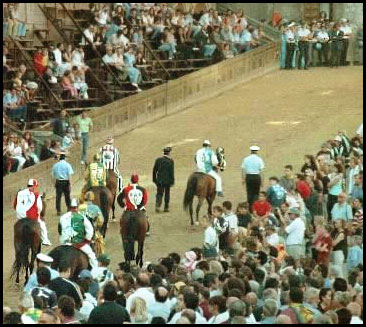
corners. Particularly dangerous is the San Martino corner, pictured in
these photographs. Because falls are so frequent, riderless horses are
allowed to place in and win the race. The jockeys, brought in from
Sardinia and other countrified parts of Italy, are allowed to whip not
only their own horses, but the horses of their opponents, or their
opposing riders. The neighborhoods select riders and jockeys by lot
shortly before the running of the race. Excitement runs high: "The
Palio lasts all year," is an informal motto of the race, meaning that
a victory in the race gives luck and blessing to the winning contrade
all year round. Second place, however, is considered an outright loss
- an indication that a jockey was in a position to carry home the
Palio victory, but held back owing to cowardice or corruption. The
uniforms worn by the jockeys indicate the contrade they ride for. In
the 2000 running, the Istrice (Porcupine) contrade
barely nosed out a riderless horse.
[ Next page ] |
 |